Howdy bloggers. Recently my good pal from OSU Ben Coleman came to visit and we had a helluva good time. He meticulously blogged about it, which you can read about here: Coleman's Bolivia Blog
Enjoy!
19 June 2008


12 May 2008
“Allí andamos, de pelotas en la selva, debajo de los ojos del escorpión...”
**The following entry actually happened almost eight months ago. After I returned from the trip, blogging about it went to the top of my to-do list. I am just now getting around to it. Some things never change.**
PROLOGUE…
It’s hard to actually determine at what point the adventure begins. Some might argue that in Bolivia, the adventure never ends. But as far as this particular story goes, I suppose it begins with the ride out to the jungle. Carlos and I had arrived the night before to Hardeman, after missing what I thought was the last bus and then surviving a tiny collision on the way home while we were on the actual last bus. I set my alarm for 6am, knowing we had some last minute details to get together before we made the trip to Jenecherú.
The first time I made the trip to Jenecherú (an indigenous word that means “indistinguishable flame”) was a couple of weeks prior to attend a meeting and talk about drilling wells in the area. It is a fairly new community, just getting off the ground. It is made of groups of people called “sindicatos” who are settling this land to farm it. Currently, it is mostly jungle with a few narrow dirt paths serving as the major byways. Each sindicato contains between 30-50 familes who are usually from the same town and are familiar with each other. It is like a group of neighbors who have gotten together to go out and stake their claim in what is essentially the Bolivian frontier. When you hear horror stories of thousands of acres of rainforest being chopped down each day, this is exactly the place you are hearing about. I will get to the ethical implications of this later on.
The meeting I attended was leaders of all 12 sindicatos in Jenecherú and immediately afterwards, a jovial fellow named Don Máximo approached me about wanting a well for his group. I gave him the usual rundown and told him as soon as he got me $150, we could set a date to drill. He showed up in Hárdeman with the cash about a week later and we decided to start drilling the following week on September 11th.
My cell phone alarm tore me out of sleep early that Tuesday morning, but I didn’t mind, it was drilling day! I hurried up and made Carlos some coffee, the Colombian part of him won’t get going until he’s had some. After the average breakfast of fresh bread and coffee, we started packing up for a few days in the jungle. Don Máximo showed up in Hárdeman around 9am but the pickup truck he had arranged for transport needed some work done, so we were at the mercy of the auto mechanic. I was a little peeved that I got up early in vain, but it’s really my fault for still not learning that things never happen on time in Bolivia. The truck and driver showed up around 4pm, with the animated Don Tiko behind the wheel. Don Tiko lives in Hardeman but this was the first time I had met him. We spent the next hour or so loading up the tiny pick-up with well materials, camping gear, extra water and Don Máximo’s bicycle went on top. Two more sindicatos had paid me for wells, so we had materials for 3 wells going up with us. To save room I suggested we lose one of the 2 spare tires, an idea which everyone else shot down. This would prove to be the gods smiling down on us. Joe Ranz would be quite proud of this packing/tying job…
This photo does not include the two people and one bike that topped off the entire Beverly Hillbillies-esque entourage in the back. Carlos, Don Tiko and myself would be squeezing into the two bucket-seats in the front cab. It was going to be a long ride.
Don Tiko offered to let Carlos drive the first leg and ride in the back to make it a little more comfortable, which was nice. He then reached in, switched the key to “on” and then dug out two wires from behind the dashboard and struck them together to spark, straight out of MacGyver. The truck roared to life and Carlos and I exchanged somewhat worried glances. Tiko gave us a big ‘ol reassuring smile and added “oh yeah, the brakes are out, so don’t go too fast, ok?” At this Carlos and I let out a roar of laughter…we knew we were in for a treat. I know it sounds kind of insane to agree to stay in this truck without brakes, but you need to remember that not only are there absolutely no inclines or declines where I live, the road and truck are in such horrible condition that it is impossible to go very fast at all. We did have to stop at one point when Don Máximo dropped something out of the back, which means Carlos just down-shifted as hard as he could and I stuck my foot out Fred Flintstone style to bring us to a stop.
Our first point of interest was a river crossing, about an hour into the ride. There was a log bridge we rolled across and waiting for us on the other side was this huge fig tree. Check it out:

To give you some perspective of the size, here is the tree with me in the shot:

Our next point of interest was when we got a flat tire. Those two spares didn’t seem so silly now. Don Máximo and Don Tiko quickly fixed the tire and we were back on the road after being eaten up by mosquitoes during our stop. It was a slow ride, but Tiko turned out to be very friendly and very interested in what we were doing, so we basically spent the whole ride talking shop. It was nice having Carlos there to do some talking as well. We stopped in a tiny little town without electric for a quick dinner and some refreshments. On the way out of town we saw a huge crowd of people gathered around the one television in town running on a generator. They were watching Bloodsport with Jean-Claude Van Damme, one of my all time favorites and I was a little disappointed we weren’t staying. Another hour or so down the road we came upon some big fires burning. Tiko explained to us that this was how people cleared the land to farm and that it really was a shame that there was no one controlling it, they were just allowed to run free and burn whatever they want. The worst part of it is that we were right on the border of a national forest, but the borders were not clearly drawn or maintained, so it was very possible that national forest was being burnt down. Here is a shot of the flames:

Our next bump in the road came when we got another flat tire. That’s right, two on the same trip! Good thing we had both spares with us…antsy to get there, Carlos and I took charge on changing this one and got it done in a jiffy.
 Nothing like changing a tire in the middle of the jungle in the middle of the night.
Throughout all of this, Carlos and I were constantly saying “this story just keeps getting better and better.” We had no way of knowing that it wouldn’t stop getting better until it was completed.
After 7 hours or so of bouncing around in Don Tiko’s cab, we finally made it to our destination around 1:30am. We set up camp and shared a nice midnight snack of crackers and cheese on a stump for a table.

Never have crackers and cheese tasted so good. We fell asleep with our heads still bouncing around the cab of Tiko’s pickup.
MIERCOLES EL 12 de SEPTIEMBRE
06:30 – Carlos and I are awoken by the sunlight. There are various men meandering around the area where we have been sleeping. A family of huge bright blue macaws flies over, announcing the beginning of another day. The men see that we are awake and encourage us to come over to the fire for the coffee. We delightfully agree and enjoy a nice cup of campo coffee and get to know our drilling crew. During breakfast we realize we are in a small man-made clearing and that we are surrounded by pure jungle. This truly is the Bolivian frontier.
 The Colombian with his café, enjoying the first rays of sun.
Campo coffee is my name for what we get out in the middle of nowhere. Coffee grounds (perhaps from yesterday, perhaps from a week ago) are boiled over a fire in a pot for about five minutes. Once removed from the fire, approximately a pound of sugar is added. This is very important. I once went to drink some without sugar (because I had had enough sugar) and they screamed and stopped me as if I were Indiana Jones drinking the poisoned blood of Mola Ram, claiming that it didn’t have sugar yet. Anyway, the piping hot sugary coffee is poured into your cup (grounds and all), which is made of tin and therefore conducts the heat directly to your hands. Sounds like a bad experience, but it is surprisingly enjoyable.
07:30 – Carlos and I start giving instructions for the first steps the group needs to take. A few begin digging the hole that will be our water holding pool

some others begin building the drilling tower,

and another crew goes with Tiko to bring back water in barrels for drilling.
The water they bring back is so green it looks like antifreeze. But it will have to do. Oh, and the barrels were recently used to house diesel fuel, so the smell lingers…at least we know the water will be disinfected…
10:15 – During prep Carlos reviews my tool bag and asks if I have an emergency hook for fishing out the pipe if it breaks, just in case. I say no and tell him he sounds like my old man saying “just in case.” He replies by asking if he can whip me with his belt like my old man if we need the hook. We both laugh but he is still worried about the lack of hook. This whole paragraph has been foreshadowing…
11:00 – All the prep work is done, we all know each other, we have explained how the process works and we begin pulling. Don Máximo is a good leader of his people and ensures they listen to us. His energy and animation go a long way to make the whole job go a lot easier. Again, it helps that Carlos is here to quickly respond to Don Máximo’s dirty jokes with jokes of his own. I understand the jokes, but I have yet to learn any of my own dirty jokes in Spanish. The beginning of the drilling is a little sticky and the pipe gets clogged fairly often. Once we make it past the first 5 meters or so, the ground is fine and we progress without issues until…
15:27 – Disaster strikes! The pipe breaks 15 meters down. This can be fatal depending on the situation and time is of the essence. The rig needs to be pulled out as quickly as possible because there is the chance of a cave-in. If the borehole collapses while the rig is dropped down in there, it is next to impossible to rescue. We learned this the hard way by losing our rig on the first well we drilled on our own. There have been miracle stories of digging down by hand to pull it out and also hooking up a tractor and pulling it out once it was stuck, but none of those are very appealing. It is much better to pull it out as quick as possible before it caves in. The good news was that we had not drilled through very much sand, which greatly reduces the chance of a collapse. We had seen mostly clay, which was good news for us. Still, we needed to get the rig out.
This is the part where Carlos saves the day. Like an over confident rookie, I donot have a fishing hook to assist in pulling out the rig. Carlos explains what he needs with concern and haste in his voice and within five minutes someone has brought him a small length of thin re-bar. Using his bear hands and a monkey wrench, Carlos bends the steel rod into the shape of an “S” and sharpens one end with a hacksaw and a file. He then beats on it a little with a hammer, using a log as his anvil. Meanwhile, I am cutting up some pipe to make the other part of the hook. I’d say within 10 minutes, we have our fishing tool ready. Here are couple of shots of the master at work:
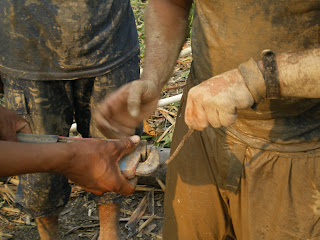

Once we get the hook made, we connect some of the plastic pipes to it and stick it down in the borehole. The trick is to either get the hook to grab on one of the couplings or to stick the hook inside the pipe and have it dig in enough to be able to pull the whole thing out. This is a very tricky process, since you have to do it completely by touch. The borehole is only 2 inches wide, so you can’t see anything you are doing. I liken it to a surgeon using one of those fiber optic deals and working off of a tv screen, only we didn’t have a screen. Also, the only thing we stood to lose were some pipes and a lot of hard work, not someone’s life. So I guess it’s a little different.
“Fishing” is a fine art that one masters only with practice and patience. We both tried, but Carlos finally came up with the rig after about 10 more minutes of trying. We get it out, fix the broken pipe, applaud everyone’s ingenuity, and go on working.
18:30 – The sun is going down and we decide to stop for the day at 20 meters of depth. Not a bad day’s work considering we did all the prep work this morning and had to fish out a broken rig.
19:00 – After a modest dinner, Don Máximo accompanies us to a water pump about 1.5 kilometers away, where we can pump a bucket of water and wash all the mud off our filthy bodies. Carlos and I enjoy the cool showers but soon realize we haven’t brought any clean clothes to put back on. We start back in nothing but our wet underwear, along the jungly path with nothing but the stars and a bit of moonlight as companions. I can’t really explain it, but for some reason I get the urge to continue on naked. I imagine it was just being in such a secluded, natural place that made me want to be “one with nature.” I suppress the desire, sure that Carlos would think me a bit unstable. Not 30 seconds later, Carlos stops and says, “bueno ya me dió las ganas de andar desnudo. No me mires.” Much to my surprise, he has had the same urge and is pulling off his underwear. I quickly follow suit, and there walk two jungle adventurers in nothing but our birthday suits. To add to the effect, Carlos has a shotgun slung around his shoulder and I am carrying a machete. I am pretty bummed I don’t have a picture because as lame as it sounds, it was a pretty beautiful moment. We get back to camp and hopp back into our shorts before anybody else sees us. Lord knows we wouldn’t have heard the end of that for the rest of the week.
20:30 – Lights out. A long day of work ahead of us tomorrow. (This is actually an incorrect phrase to use, since the lights technically went out two hours earlier when the sun went down.)
JUEVES EL 13 de SEPTIEMBRE
06:42 – Awakened to the quiet sounds of the jungle. I crawl out of my tent, overcoming the morning soreness that always awaits you after a day of drilling. A few of the fellows are up and sitting around a pot of campo coffee and they invite me over. A few of the more industrious of the group had gone out hunting during the night and were eager to show us the booty, a rodent of an animal called Jochi Pintado which means “Painted Jochi.” I’m not sure if there is an English word for a Jochi, but it sure is good eatin’.
 We would meet again over lunch…
08:00 – Work on the well begins again. To avoid clogging of the rig, we do not start immediately at the 20m mark we left yesterday. We start at about 12 meters, re-circulating the water and mud that is in the hole, slowly advancing down to 20 meters. We are back to 20 within a half hour.
08:30-18:00 – We advance at a regular pace, hitting one small layer of sand (where the water is) at 30m but decide to continue, hoping for a larger layer a little deeper. Throughout the day I began working on building the filter and Carlos worked on building the home-made pump. Everything we use can be bought cheaply at any hardware store, and is therefore easy to construct and repair. Our filter made of slotted pipe wrapped in a plastic rice bag and sealed at the bottom with electrical tape.
 The key part of our home-made pump, made of small coupling and nipple with a leather seal and then hacked up a bit with a hacksaw.
That afternoon it had been decided amongst the workers that if weren’t done by that evening, we’d continue working throughout the night. While I wasn’t thrilled at the prospect of not sleeping, it’s always fun staying up late out in the middle of the jungle. We had another modest dinner of rice and left-over bites of jochi (taking turns while the work continued of course) and a few of the fellas put together a big fire nearby the drilling site to keep things lit throughout the night.
22:00 – Bad luck again, the pipe breaks. Only this time much deeper and we had passed a sand layer. This means there was more of a chance of collapse than before, and also that it was going to be much heavier to pull out. After about 15 or 20 minutes of “fishin’ in the dark” we got our prize. This didn’t deter anyone and we kept on truckin’. Here’s a shot of me manning the spout by firelight:

VIERNES EL 14 de SEPTIEMBRE
00:06 – I am spending my 20-30 minute breaks sleeping in the “Y” of a big fallen tree next to the fire. If it’s one thing I’ve learned to do in Bolivia, it’s sleep anywhere. Who am I kidding…I did this long before I came to Bolivia. Like father, like son.
It is a surreal feeling around the work-site. Carlos and I, usually fairly animated are fairly silenced by weariness. The workers plow on, ignoring the pain in their shoulders and backs, enjoying their 30 minute naps when they get them. Our friend Don Máximo talks quietly with one of them. The sounds dominating the landscape are the crackle of the fire and the constant spit of the drilling spout into the catch pit. Around us is nothing but pitch-black jungle, no doubt with all kinds of interesting critters wondering what on earth we are doing, aside from damaging their homes.
02:00 – We call it quits for the night at 47m. Don Máximo says he can go on, but the rest welcome a respite. Carlos and I are worried that a tired person (most likely one of us) is going to drop a tool down the well, possibly rendering the whole thing useless and mandating us to start again from the beginning. So stopping is a good idea.
02:04 – We do our best to wipe off the majority of the mud caked on our bodies, but most of it just ends up in our sleeping bags with us. There are no worries when you’re this tired.
07:00 – It’s impossible to sleep past 7am when you’re camping and the sun is up almost two hours beforehand. No matter how much your shoulders scream for more rest or how loud your joints crack when you move, it’s time to get up. Everyone else is already awake, as if it were no big deal that we busted our asses for 18 hours straight yesterday.
08:30 – We are off and going again. Again, within about 30 minutes we are back to last night’s stopping point of 47 meters. Since Carlos and I are the only ones who have drilled wells before, he and I have been taking turns working the “spout” end while the rest of the workers are pulling the rope in teams of four. The spout end is important because you have to be able to feel what type of ground we are going through and have to be ready to take samples to find out exactly what is coming out. This takes a little experience, and by the end of the drilling, we can trust one or two of the workers to do it right with a little supervision. Here is a shot of me working the spout with the pulling team in the background:

09:45 – Sand! Finally! We are at 51 meters and were getting worried we weren’t going to hit anything before 60 meters, which is as deep as we can go. We keep drilling through the sand layer and find out it’s about 2 meters long, which isn’t ideal but it will have to do. Usually we want AT LEAST 3 meters of sand. But after all we’ve been through, we’re going to make this work.
10:15 – We pull the rig up to change bits. Up until this point, we have been drilling with a 1 ¼ inch bit and now we need to widen our borehole to 2 inches so the casing tubes will fit. This is a much less arduous process, but still takes a few hours, especially on a deep well like this. It represents a lot of work, but also means that there is a light at the end of the tunnel and that the end is in sight. We all breathe a brief sigh of relief.
13:38 – The sigh of relief is over, because now the pulley has broken! This I did not foresee in my wildest dreams. Carlos scolds me again for not always having two pulleys (if it were up to him, we’d have 5 of EVERYTHING in our toolbag and need a semi to carry it all around) but I can honestly say I have never heard of this happening. Carlos immediately begins to try and fashion a new pin for the pulley out of I don’t even know what when one of the workers shows up out of nowhere with a pulley. I have no idea from whence it came but we hook it up and forge ahead. Good thing too, because Carlos wasn’t getting very far with his “new” design.
16:00 – We’ve finished widening out the borehole and we finally case the well without issue. This brings on an even bigger sigh of relief, but the work is not completely done yet. The vast majority of the manual labor is done though, and we can all relax a little. However, the water could come up salty still, which is no one’s fault but always a risk. Also, if the filter was poorly made there might be sand coming in through it. Only Carlos and I really know this though, so he and I are the only apprehensive ones.
16:25 – They have brought more water and we begin developing a well, a process that involves pumping water down the well and forcing it out through the screen to “develop” the aquifer around it. After we pump water down, we pump all the water out of the well, and then more down. This helps to create an additional filter out of the sand in the aquifer, bringing the largest grains of sand closest to our screen and keeps the finest grains furthest away. We pump down a barrel or two of water, during which Carlos and I decide to take baths in the less-than-clean water:
 Better than nothing. Or is it?
18:30 – We break for a quick dinner and rest. We will develop a little more after dinner, but we will most likely finish everything tomorrow. The rest is much appreciated.
19:15 – Back at the drilling site (just across the way from our “mess hall”) and we continue with development and good news! The water begins clearing up! This is our sign to pump it dry and see how quickly it recharges a few times.
20:30 – Success! The well is charging at a good rate and the water coming up is clear and salt-free! It’s time to install the pump, the details of which we have finished up during the development process. A kind soul gets our fire going again so we can see better and keeps us warm. Carlos and I have our own little celebration by the fire, roasting some marshmallows I’ve smuggled into the jungle. By this time, all the workers and other members of the community have crowded around to see what their blood, sweat and tears has earned them. Don Máximo is pumping the well and Carlos is splashing everyone, letting out yells of “¡Agua para todo el mundo!” At which everyone laughs and enjoys the fresh, cool water.
 Don Máximo checking out our handywork.

One of our workers cleaning off his hands for the first time in his pueblo.

 Exchanging gratitude…

Carlos and I with our faithful driver Don Tiko, and our wonderful cook Doña Etna. These were definitely two of the key players in our adventure.
22:15 – The excitement has died down, but Carlos and I are in a rush to get our things together. Tiko tells us he’d rather leave right away and since he is the man with the keys (and the wires) to the truck, we comply. We make sure we say goodbye and thank you to everyone, making sure they know how to fix everything if breaks and also give them the details on how to put the finishing touches on the pump tomorrow. We quickly break camp and load up our stuff into Tiko’s truck, not quite sure what to expect of the likely all-night ride back to Hárdeman.
23:00 – And we’re off! We’ve assured Don Tiko that we will do our best to stay awake during our journey, to keep him company. At least we’ll take turns. Also, it won’t hurt to puff on a few cigarettes. In return Don Tiko tells us that his battery is dying and is pretty sure it won’t last all night with the headlights. So whenever we can, we’ll drive without the headlights. Something like this any other time may seem strange, but after the week we’ve had, Carlos and I just shrug our shoulders and say ok. The three of us are up front again, and our hardest worker, young Alberto, is in the back. He has to get back to Montero, where he is studying. He has spent his vacation with us, learning how to drill wells. We’d love to teach him some more if we get the chance.
SABADO EL 15 de SEPTIEMBRE
02:30 – We have come to the first major obstacle in the road. Literally. Remember those guys that were burning down the forest on the way in? Well, they made it all the way down next to our road and managed to burn a tree down so it fell directly in our path!
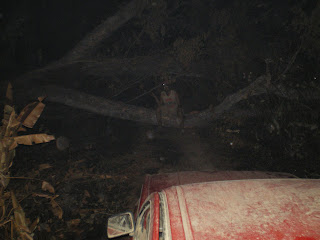
Low on options, we have to find a way around the tree. Surprisingly enough, in a vehicle also carrying two Bolivians and one “always prepared” Colombian, I happen to be the only one with a machete. Alberto gets to quick work hacking through the woods, making a tiny path around the tree stump for Tiko to drive around. Tiko helps him out all he can with a shovel, which really isn’t much. After about an hour of hacking, they have cut a sufficient path through the woods, and Tiko blazes on through, going around the stump whilst it still burns! Of course I don’t think you’ll believe me, so here’s a photo:

03:45 – Literally on the other side of the tree we come to a bridge, on the other side of which is parked a huge truck, who decided to camp there for the night when he saw the fallen tree on the other side. There is no other way around the truck, the brush is too thick to hack through on that side. At this point, Tiko turns off the truck for some reason. I am not sure why, since we have next to no battery power. He heads over to the driver of the other truck, trying to convince him to cross the bridge so we could get by. But before he does this, we need him to wait a bit so we can get our truck started again. This proves to be trickier than Tiko thought. The battery is all but dead, so here we are in the middle of the night in the middle of the jungle pushing this pick-up back and forth, trying to kick-start it with no luck. So Tiko has the driver come across the bridge and in the process nearly demolish our truck. The other truck also has almost no battery power, and has to kick-start itself coming down the small incline onto the bridge. Quite a gamble I’d say. Tiko then spends the next hour switching the batteries out, trying to charge one in a way that I don’t find very efficient. Meanwhile, Carlos is cashed out in the back, finally giving into his weariness.

¡Pobrecito!
05:15 – We are back on “the road,” only needing the headlights for a little while longer since the sun is on its way to shining again. Our last stop before Hárdeman is the bridge by the big tree we crossed on the way here. To our surprise, Tiko turns off the truck when we arrive and says “come on, I want you to meet someone.” The gate to the bridge is locked, and the keymaster is an ancient old man named Don Manuel, who turns out to be a friend of Tiko’s. One might consider this a Bolivian toll booth. Don Manuel is of course up with the sun every day and when we find him he is performing his morning ritual of milking the cows. We chat it up with Don Manuel and grin as he throws insults left and right to the immigrants from the west, the kollas. I grin not because he’s a racist, but because the things he says are so far-fetched and ridiculous, they can only be received with jest. He likes that we laugh and offers up some fresh milk. As fresh as it gets. I have managed to save some bread and we share that with him and we have a nice breakfast along the riverbank. Even though we are essentially without sleep, the crisp morning and the warm milk refresh us for the new day. As I write about it now, some months later, I am reminded of a scene from The Grapes of Wrath when the Joads are staying at the government camp. Tom goes out looking for work and comes across a small family cooking breakfast on a similarly crisp morning. Tom pulls up a spot around the stove and they gladly share what they have with him, pleased to have his company. I will take this moment to claim that John Steinbeck is a genius.
 Does a body good!
We thank Don Manuel and our on our way, finally on the very last leg of our trip.
07:25 – Back in Hárdeman once again. Our 8.5 hour return trip is even longer than the trip there, something we thought to be impossible. Carlos has things to attend to back home and hops directly on the 8am bus, even skipping his morning coffee. I see Carlos off and stay out to chat for a while with a few neighbors who are just starting their day. Eventually I make my way back to my room. I’m asleep before I hit the mattress. The adventure has ended.
Epilogue…
That afternoon, I made my way to the plaza to write a letter to a friend and mentor of mine. I was feeling a little conflicted and wanted to get some things down on paper. Don Máximo had said something to me that truthfully rattled me a little. He said with all gratitude and thanks, “Because of this well, this area is going to grow a lot faster. Many people will want to come here to this spot because there is clean water. Thank you.” I cringed at the thought of more people immigrating to that area, cutting down more trees, destroying more land so it can be farmed. I thought of the burning down of the forest that we saw on the way there and back, picturing it on a grand scale. It’s an ugly thing. But then I think that I cannot prevent people from going out there, claiming land, and farming it. They are going to do it regardless of whether or not I am here. They are going to go, so helping them at least have clean water and staying healthy is not so bad. But then again, it IS so bad. Better that they go, see that there is no clean water, get deathly ill from some contaminated water they drink, and never ever want to go back. The more people we turn away from domesticating the jungle, the better. Perhaps the blame should go to the government? For not protecting their beautiful landscape better? I don’t know about this…in America we are very used to the government laying down rules and regulations and people following them. This is a strategy that simply does not work in Bolivia. Sure there are laws, but nobody follows them, and as a result nobody gets in trouble either.
So is what I am doing wrong? Perhaps. I am certainly not helping the global-warming cause. I am helping some people live better, healthier lives. But in this case, considering that these people are doing pretty bad things (albeit unknown to them), I am not sure that is such a worthy cause. Perhaps every person working in development has a similar internal argument. That we should just leave these cultures alone to fend for themselves and if they survive, they are selected and if they don’t…well it’s survival of the fittest, right?
Here is what I really believe. If we abandon these people, we abandon them to the bad things. We leave them to be dominated by Van Damme movies, Michael Jackson music videos and Coca Cola. To be controlled by the oil companies and governments on the other side of the world. These huge, overarching organizations and businesses are precisely what make it to the developing world. I have been to some far corners of some far places, but there is always coke available relatively nearby and there is always someone asking if I know Bill Clinton or am related to Bruce Lee. So, if we abandon these people, all of those groups win. Coca cola will run the world. So the truth is, I find solace in representing the “developed” world and America in this fashion. These people do not deserve to be thrown to the dogs, which is precisely what will happen if we let these groups continuing their essential domination of the earth.
I believe it is true that we are consuming the earth at an alarming rate, but the solution is not to abandon the little guy. They are in the position they are in because of the first world's irresponsible actions. I am not sure we can save everything, but we can make it easier for a few people along the way. I will now step down from my soapbox.
PROLOGUE…
It’s hard to actually determine at what point the adventure begins. Some might argue that in Bolivia, the adventure never ends. But as far as this particular story goes, I suppose it begins with the ride out to the jungle. Carlos and I had arrived the night before to Hardeman, after missing what I thought was the last bus and then surviving a tiny collision on the way home while we were on the actual last bus. I set my alarm for 6am, knowing we had some last minute details to get together before we made the trip to Jenecherú.
The first time I made the trip to Jenecherú (an indigenous word that means “indistinguishable flame”) was a couple of weeks prior to attend a meeting and talk about drilling wells in the area. It is a fairly new community, just getting off the ground. It is made of groups of people called “sindicatos” who are settling this land to farm it. Currently, it is mostly jungle with a few narrow dirt paths serving as the major byways. Each sindicato contains between 30-50 familes who are usually from the same town and are familiar with each other. It is like a group of neighbors who have gotten together to go out and stake their claim in what is essentially the Bolivian frontier. When you hear horror stories of thousands of acres of rainforest being chopped down each day, this is exactly the place you are hearing about. I will get to the ethical implications of this later on.
The meeting I attended was leaders of all 12 sindicatos in Jenecherú and immediately afterwards, a jovial fellow named Don Máximo approached me about wanting a well for his group. I gave him the usual rundown and told him as soon as he got me $150, we could set a date to drill. He showed up in Hárdeman with the cash about a week later and we decided to start drilling the following week on September 11th.
My cell phone alarm tore me out of sleep early that Tuesday morning, but I didn’t mind, it was drilling day! I hurried up and made Carlos some coffee, the Colombian part of him won’t get going until he’s had some. After the average breakfast of fresh bread and coffee, we started packing up for a few days in the jungle. Don Máximo showed up in Hárdeman around 9am but the pickup truck he had arranged for transport needed some work done, so we were at the mercy of the auto mechanic. I was a little peeved that I got up early in vain, but it’s really my fault for still not learning that things never happen on time in Bolivia. The truck and driver showed up around 4pm, with the animated Don Tiko behind the wheel. Don Tiko lives in Hardeman but this was the first time I had met him. We spent the next hour or so loading up the tiny pick-up with well materials, camping gear, extra water and Don Máximo’s bicycle went on top. Two more sindicatos had paid me for wells, so we had materials for 3 wells going up with us. To save room I suggested we lose one of the 2 spare tires, an idea which everyone else shot down. This would prove to be the gods smiling down on us. Joe Ranz would be quite proud of this packing/tying job…

This photo does not include the two people and one bike that topped off the entire Beverly Hillbillies-esque entourage in the back. Carlos, Don Tiko and myself would be squeezing into the two bucket-seats in the front cab. It was going to be a long ride.
Don Tiko offered to let Carlos drive the first leg and ride in the back to make it a little more comfortable, which was nice. He then reached in, switched the key to “on” and then dug out two wires from behind the dashboard and struck them together to spark, straight out of MacGyver. The truck roared to life and Carlos and I exchanged somewhat worried glances. Tiko gave us a big ‘ol reassuring smile and added “oh yeah, the brakes are out, so don’t go too fast, ok?” At this Carlos and I let out a roar of laughter…we knew we were in for a treat. I know it sounds kind of insane to agree to stay in this truck without brakes, but you need to remember that not only are there absolutely no inclines or declines where I live, the road and truck are in such horrible condition that it is impossible to go very fast at all. We did have to stop at one point when Don Máximo dropped something out of the back, which means Carlos just down-shifted as hard as he could and I stuck my foot out Fred Flintstone style to bring us to a stop.
Our first point of interest was a river crossing, about an hour into the ride. There was a log bridge we rolled across and waiting for us on the other side was this huge fig tree. Check it out:

To give you some perspective of the size, here is the tree with me in the shot:

Our next point of interest was when we got a flat tire. Those two spares didn’t seem so silly now. Don Máximo and Don Tiko quickly fixed the tire and we were back on the road after being eaten up by mosquitoes during our stop. It was a slow ride, but Tiko turned out to be very friendly and very interested in what we were doing, so we basically spent the whole ride talking shop. It was nice having Carlos there to do some talking as well. We stopped in a tiny little town without electric for a quick dinner and some refreshments. On the way out of town we saw a huge crowd of people gathered around the one television in town running on a generator. They were watching Bloodsport with Jean-Claude Van Damme, one of my all time favorites and I was a little disappointed we weren’t staying. Another hour or so down the road we came upon some big fires burning. Tiko explained to us that this was how people cleared the land to farm and that it really was a shame that there was no one controlling it, they were just allowed to run free and burn whatever they want. The worst part of it is that we were right on the border of a national forest, but the borders were not clearly drawn or maintained, so it was very possible that national forest was being burnt down. Here is a shot of the flames:

Our next bump in the road came when we got another flat tire. That’s right, two on the same trip! Good thing we had both spares with us…antsy to get there, Carlos and I took charge on changing this one and got it done in a jiffy.
 Nothing like changing a tire in the middle of the jungle in the middle of the night.
 Throughout all of this, Carlos and I were constantly saying “this story just keeps getting better and better.” We had no way of knowing that it wouldn’t stop getting better until it was completed.
After 7 hours or so of bouncing around in Don Tiko’s cab, we finally made it to our destination around 1:30am. We set up camp and shared a nice midnight snack of crackers and cheese on a stump for a table.

Never have crackers and cheese tasted so good. We fell asleep with our heads still bouncing around the cab of Tiko’s pickup.
MIERCOLES EL 12 de SEPTIEMBRE
06:30 – Carlos and I are awoken by the sunlight. There are various men meandering around the area where we have been sleeping. A family of huge bright blue macaws flies over, announcing the beginning of another day. The men see that we are awake and encourage us to come over to the fire for the coffee. We delightfully agree and enjoy a nice cup of campo coffee and get to know our drilling crew. During breakfast we realize we are in a small man-made clearing and that we are surrounded by pure jungle. This truly is the Bolivian frontier.
 The Colombian with his café, enjoying the first rays of sun.
 Campo coffee is my name for what we get out in the middle of nowhere. Coffee grounds (perhaps from yesterday, perhaps from a week ago) are boiled over a fire in a pot for about five minutes. Once removed from the fire, approximately a pound of sugar is added. This is very important. I once went to drink some without sugar (because I had had enough sugar) and they screamed and stopped me as if I were Indiana Jones drinking the poisoned blood of Mola Ram, claiming that it didn’t have sugar yet. Anyway, the piping hot sugary coffee is poured into your cup (grounds and all), which is made of tin and therefore conducts the heat directly to your hands. Sounds like a bad experience, but it is surprisingly enjoyable.
07:30 – Carlos and I start giving instructions for the first steps the group needs to take. A few begin digging the hole that will be our water holding pool

some others begin building the drilling tower,

and another crew goes with Tiko to bring back water in barrels for drilling.

The water they bring back is so green it looks like antifreeze. But it will have to do. Oh, and the barrels were recently used to house diesel fuel, so the smell lingers…at least we know the water will be disinfected…
10:15 – During prep Carlos reviews my tool bag and asks if I have an emergency hook for fishing out the pipe if it breaks, just in case. I say no and tell him he sounds like my old man saying “just in case.” He replies by asking if he can whip me with his belt like my old man if we need the hook. We both laugh but he is still worried about the lack of hook. This whole paragraph has been foreshadowing…
11:00 – All the prep work is done, we all know each other, we have explained how the process works and we begin pulling. Don Máximo is a good leader of his people and ensures they listen to us. His energy and animation go a long way to make the whole job go a lot easier. Again, it helps that Carlos is here to quickly respond to Don Máximo’s dirty jokes with jokes of his own. I understand the jokes, but I have yet to learn any of my own dirty jokes in Spanish. The beginning of the drilling is a little sticky and the pipe gets clogged fairly often. Once we make it past the first 5 meters or so, the ground is fine and we progress without issues until…
15:27 – Disaster strikes! The pipe breaks 15 meters down. This can be fatal depending on the situation and time is of the essence. The rig needs to be pulled out as quickly as possible because there is the chance of a cave-in. If the borehole collapses while the rig is dropped down in there, it is next to impossible to rescue. We learned this the hard way by losing our rig on the first well we drilled on our own. There have been miracle stories of digging down by hand to pull it out and also hooking up a tractor and pulling it out once it was stuck, but none of those are very appealing. It is much better to pull it out as quick as possible before it caves in. The good news was that we had not drilled through very much sand, which greatly reduces the chance of a collapse. We had seen mostly clay, which was good news for us. Still, we needed to get the rig out.
This is the part where Carlos saves the day. Like an over confident rookie, I donot have a fishing hook to assist in pulling out the rig. Carlos explains what he needs with concern and haste in his voice and within five minutes someone has brought him a small length of thin re-bar. Using his bear hands and a monkey wrench, Carlos bends the steel rod into the shape of an “S” and sharpens one end with a hacksaw and a file. He then beats on it a little with a hammer, using a log as his anvil. Meanwhile, I am cutting up some pipe to make the other part of the hook. I’d say within 10 minutes, we have our fishing tool ready. Here are couple of shots of the master at work:


Once we get the hook made, we connect some of the plastic pipes to it and stick it down in the borehole. The trick is to either get the hook to grab on one of the couplings or to stick the hook inside the pipe and have it dig in enough to be able to pull the whole thing out. This is a very tricky process, since you have to do it completely by touch. The borehole is only 2 inches wide, so you can’t see anything you are doing. I liken it to a surgeon using one of those fiber optic deals and working off of a tv screen, only we didn’t have a screen. Also, the only thing we stood to lose were some pipes and a lot of hard work, not someone’s life. So I guess it’s a little different.
“Fishing” is a fine art that one masters only with practice and patience. We both tried, but Carlos finally came up with the rig after about 10 more minutes of trying. We get it out, fix the broken pipe, applaud everyone’s ingenuity, and go on working.
18:30 – The sun is going down and we decide to stop for the day at 20 meters of depth. Not a bad day’s work considering we did all the prep work this morning and had to fish out a broken rig.
19:00 – After a modest dinner, Don Máximo accompanies us to a water pump about 1.5 kilometers away, where we can pump a bucket of water and wash all the mud off our filthy bodies. Carlos and I enjoy the cool showers but soon realize we haven’t brought any clean clothes to put back on. We start back in nothing but our wet underwear, along the jungly path with nothing but the stars and a bit of moonlight as companions. I can’t really explain it, but for some reason I get the urge to continue on naked. I imagine it was just being in such a secluded, natural place that made me want to be “one with nature.” I suppress the desire, sure that Carlos would think me a bit unstable. Not 30 seconds later, Carlos stops and says, “bueno ya me dió las ganas de andar desnudo. No me mires.” Much to my surprise, he has had the same urge and is pulling off his underwear. I quickly follow suit, and there walk two jungle adventurers in nothing but our birthday suits. To add to the effect, Carlos has a shotgun slung around his shoulder and I am carrying a machete. I am pretty bummed I don’t have a picture because as lame as it sounds, it was a pretty beautiful moment. We get back to camp and hopp back into our shorts before anybody else sees us. Lord knows we wouldn’t have heard the end of that for the rest of the week.
20:30 – Lights out. A long day of work ahead of us tomorrow. (This is actually an incorrect phrase to use, since the lights technically went out two hours earlier when the sun went down.)
JUEVES EL 13 de SEPTIEMBRE
06:42 – Awakened to the quiet sounds of the jungle. I crawl out of my tent, overcoming the morning soreness that always awaits you after a day of drilling. A few of the fellows are up and sitting around a pot of campo coffee and they invite me over. A few of the more industrious of the group had gone out hunting during the night and were eager to show us the booty, a rodent of an animal called Jochi Pintado which means “Painted Jochi.” I’m not sure if there is an English word for a Jochi, but it sure is good eatin’.
 We would meet again over lunch…
08:00 – Work on the well begins again. To avoid clogging of the rig, we do not start immediately at the 20m mark we left yesterday. We start at about 12 meters, re-circulating the water and mud that is in the hole, slowly advancing down to 20 meters. We are back to 20 within a half hour.
08:30-18:00 – We advance at a regular pace, hitting one small layer of sand (where the water is) at 30m but decide to continue, hoping for a larger layer a little deeper. Throughout the day I began working on building the filter and Carlos worked on building the home-made pump. Everything we use can be bought cheaply at any hardware store, and is therefore easy to construct and repair.
 Our filter made of slotted pipe wrapped in a plastic rice bag and sealed at the bottom with electrical tape.
 The key part of our home-made pump, made of small coupling and nipple with a leather seal and then hacked up a bit with a hacksaw.
That afternoon it had been decided amongst the workers that if weren’t done by that evening, we’d continue working throughout the night. While I wasn’t thrilled at the prospect of not sleeping, it’s always fun staying up late out in the middle of the jungle. We had another modest dinner of rice and left-over bites of jochi (taking turns while the work continued of course) and a few of the fellas put together a big fire nearby the drilling site to keep things lit throughout the night.
22:00 – Bad luck again, the pipe breaks. Only this time much deeper and we had passed a sand layer. This means there was more of a chance of collapse than before, and also that it was going to be much heavier to pull out. After about 15 or 20 minutes of “fishin’ in the dark” we got our prize. This didn’t deter anyone and we kept on truckin’. Here’s a shot of me manning the spout by firelight:

VIERNES EL 14 de SEPTIEMBRE
00:06 – I am spending my 20-30 minute breaks sleeping in the “Y” of a big fallen tree next to the fire. If it’s one thing I’ve learned to do in Bolivia, it’s sleep anywhere. Who am I kidding…I did this long before I came to Bolivia. Like father, like son.
It is a surreal feeling around the work-site. Carlos and I, usually fairly animated are fairly silenced by weariness. The workers plow on, ignoring the pain in their shoulders and backs, enjoying their 30 minute naps when they get them. Our friend Don Máximo talks quietly with one of them. The sounds dominating the landscape are the crackle of the fire and the constant spit of the drilling spout into the catch pit. Around us is nothing but pitch-black jungle, no doubt with all kinds of interesting critters wondering what on earth we are doing, aside from damaging their homes.
02:00 – We call it quits for the night at 47m. Don Máximo says he can go on, but the rest welcome a respite. Carlos and I are worried that a tired person (most likely one of us) is going to drop a tool down the well, possibly rendering the whole thing useless and mandating us to start again from the beginning. So stopping is a good idea.
02:04 – We do our best to wipe off the majority of the mud caked on our bodies, but most of it just ends up in our sleeping bags with us. There are no worries when you’re this tired.
07:00 – It’s impossible to sleep past 7am when you’re camping and the sun is up almost two hours beforehand. No matter how much your shoulders scream for more rest or how loud your joints crack when you move, it’s time to get up. Everyone else is already awake, as if it were no big deal that we busted our asses for 18 hours straight yesterday.
08:30 – We are off and going again. Again, within about 30 minutes we are back to last night’s stopping point of 47 meters. Since Carlos and I are the only ones who have drilled wells before, he and I have been taking turns working the “spout” end while the rest of the workers are pulling the rope in teams of four. The spout end is important because you have to be able to feel what type of ground we are going through and have to be ready to take samples to find out exactly what is coming out. This takes a little experience, and by the end of the drilling, we can trust one or two of the workers to do it right with a little supervision. Here is a shot of me working the spout with the pulling team in the background:

09:45 – Sand! Finally! We are at 51 meters and were getting worried we weren’t going to hit anything before 60 meters, which is as deep as we can go. We keep drilling through the sand layer and find out it’s about 2 meters long, which isn’t ideal but it will have to do. Usually we want AT LEAST 3 meters of sand. But after all we’ve been through, we’re going to make this work.
10:15 – We pull the rig up to change bits. Up until this point, we have been drilling with a 1 ¼ inch bit and now we need to widen our borehole to 2 inches so the casing tubes will fit. This is a much less arduous process, but still takes a few hours, especially on a deep well like this. It represents a lot of work, but also means that there is a light at the end of the tunnel and that the end is in sight. We all breathe a brief sigh of relief.
13:38 – The sigh of relief is over, because now the pulley has broken! This I did not foresee in my wildest dreams. Carlos scolds me again for not always having two pulleys (if it were up to him, we’d have 5 of EVERYTHING in our toolbag and need a semi to carry it all around) but I can honestly say I have never heard of this happening. Carlos immediately begins to try and fashion a new pin for the pulley out of I don’t even know what when one of the workers shows up out of nowhere with a pulley. I have no idea from whence it came but we hook it up and forge ahead. Good thing too, because Carlos wasn’t getting very far with his “new” design.
16:00 – We’ve finished widening out the borehole and we finally case the well without issue. This brings on an even bigger sigh of relief, but the work is not completely done yet. The vast majority of the manual labor is done though, and we can all relax a little. However, the water could come up salty still, which is no one’s fault but always a risk. Also, if the filter was poorly made there might be sand coming in through it. Only Carlos and I really know this though, so he and I are the only apprehensive ones.
16:25 – They have brought more water and we begin developing a well, a process that involves pumping water down the well and forcing it out through the screen to “develop” the aquifer around it. After we pump water down, we pump all the water out of the well, and then more down. This helps to create an additional filter out of the sand in the aquifer, bringing the largest grains of sand closest to our screen and keeps the finest grains furthest away. We pump down a barrel or two of water, during which Carlos and I decide to take baths in the less-than-clean water:
 Better than nothing. Or is it?
18:30 – We break for a quick dinner and rest. We will develop a little more after dinner, but we will most likely finish everything tomorrow. The rest is much appreciated.
19:15 – Back at the drilling site (just across the way from our “mess hall”) and we continue with development and good news! The water begins clearing up! This is our sign to pump it dry and see how quickly it recharges a few times.
20:30 – Success! The well is charging at a good rate and the water coming up is clear and salt-free! It’s time to install the pump, the details of which we have finished up during the development process. A kind soul gets our fire going again so we can see better and keeps us warm. Carlos and I have our own little celebration by the fire, roasting some marshmallows I’ve smuggled into the jungle. By this time, all the workers and other members of the community have crowded around to see what their blood, sweat and tears has earned them. Don Máximo is pumping the well and Carlos is splashing everyone, letting out yells of “¡Agua para todo el mundo!” At which everyone laughs and enjoys the fresh, cool water.
 Don Máximo checking out our handywork.
One of our workers cleaning off his hands for the first time in his pueblo.

 Exchanging gratitude…
Carlos and I with our faithful driver Don Tiko, and our wonderful cook Doña Etna. These were definitely two of the key players in our adventure.
22:15 – The excitement has died down, but Carlos and I are in a rush to get our things together. Tiko tells us he’d rather leave right away and since he is the man with the keys (and the wires) to the truck, we comply. We make sure we say goodbye and thank you to everyone, making sure they know how to fix everything if breaks and also give them the details on how to put the finishing touches on the pump tomorrow. We quickly break camp and load up our stuff into Tiko’s truck, not quite sure what to expect of the likely all-night ride back to Hárdeman.
23:00 – And we’re off! We’ve assured Don Tiko that we will do our best to stay awake during our journey, to keep him company. At least we’ll take turns. Also, it won’t hurt to puff on a few cigarettes. In return Don Tiko tells us that his battery is dying and is pretty sure it won’t last all night with the headlights. So whenever we can, we’ll drive without the headlights. Something like this any other time may seem strange, but after the week we’ve had, Carlos and I just shrug our shoulders and say ok. The three of us are up front again, and our hardest worker, young Alberto, is in the back. He has to get back to Montero, where he is studying. He has spent his vacation with us, learning how to drill wells. We’d love to teach him some more if we get the chance.
SABADO EL 15 de SEPTIEMBRE
02:30 – We have come to the first major obstacle in the road. Literally. Remember those guys that were burning down the forest on the way in? Well, they made it all the way down next to our road and managed to burn a tree down so it fell directly in our path!

Low on options, we have to find a way around the tree. Surprisingly enough, in a vehicle also carrying two Bolivians and one “always prepared” Colombian, I happen to be the only one with a machete. Alberto gets to quick work hacking through the woods, making a tiny path around the tree stump for Tiko to drive around. Tiko helps him out all he can with a shovel, which really isn’t much. After about an hour of hacking, they have cut a sufficient path through the woods, and Tiko blazes on through, going around the stump whilst it still burns! Of course I don’t think you’ll believe me, so here’s a photo:

03:45 – Literally on the other side of the tree we come to a bridge, on the other side of which is parked a huge truck, who decided to camp there for the night when he saw the fallen tree on the other side. There is no other way around the truck, the brush is too thick to hack through on that side. At this point, Tiko turns off the truck for some reason. I am not sure why, since we have next to no battery power. He heads over to the driver of the other truck, trying to convince him to cross the bridge so we could get by. But before he does this, we need him to wait a bit so we can get our truck started again. This proves to be trickier than Tiko thought. The battery is all but dead, so here we are in the middle of the night in the middle of the jungle pushing this pick-up back and forth, trying to kick-start it with no luck. So Tiko has the driver come across the bridge and in the process nearly demolish our truck. The other truck also has almost no battery power, and has to kick-start itself coming down the small incline onto the bridge. Quite a gamble I’d say. Tiko then spends the next hour switching the batteries out, trying to charge one in a way that I don’t find very efficient. Meanwhile, Carlos is cashed out in the back, finally giving into his weariness.

¡Pobrecito!
05:15 – We are back on “the road,” only needing the headlights for a little while longer since the sun is on its way to shining again. Our last stop before Hárdeman is the bridge by the big tree we crossed on the way here. To our surprise, Tiko turns off the truck when we arrive and says “come on, I want you to meet someone.” The gate to the bridge is locked, and the keymaster is an ancient old man named Don Manuel, who turns out to be a friend of Tiko’s. One might consider this a Bolivian toll booth. Don Manuel is of course up with the sun every day and when we find him he is performing his morning ritual of milking the cows. We chat it up with Don Manuel and grin as he throws insults left and right to the immigrants from the west, the kollas. I grin not because he’s a racist, but because the things he says are so far-fetched and ridiculous, they can only be received with jest. He likes that we laugh and offers up some fresh milk. As fresh as it gets. I have managed to save some bread and we share that with him and we have a nice breakfast along the riverbank. Even though we are essentially without sleep, the crisp morning and the warm milk refresh us for the new day. As I write about it now, some months later, I am reminded of a scene from The Grapes of Wrath when the Joads are staying at the government camp. Tom goes out looking for work and comes across a small family cooking breakfast on a similarly crisp morning. Tom pulls up a spot around the stove and they gladly share what they have with him, pleased to have his company. I will take this moment to claim that John Steinbeck is a genius.
 Does a body good!
We thank Don Manuel and our on our way, finally on the very last leg of our trip.
07:25 – Back in Hárdeman once again. Our 8.5 hour return trip is even longer than the trip there, something we thought to be impossible. Carlos has things to attend to back home and hops directly on the 8am bus, even skipping his morning coffee. I see Carlos off and stay out to chat for a while with a few neighbors who are just starting their day. Eventually I make my way back to my room. I’m asleep before I hit the mattress. The adventure has ended.
Epilogue…
That afternoon, I made my way to the plaza to write a letter to a friend and mentor of mine. I was feeling a little conflicted and wanted to get some things down on paper. Don Máximo had said something to me that truthfully rattled me a little. He said with all gratitude and thanks, “Because of this well, this area is going to grow a lot faster. Many people will want to come here to this spot because there is clean water. Thank you.” I cringed at the thought of more people immigrating to that area, cutting down more trees, destroying more land so it can be farmed. I thought of the burning down of the forest that we saw on the way there and back, picturing it on a grand scale. It’s an ugly thing. But then I think that I cannot prevent people from going out there, claiming land, and farming it. They are going to do it regardless of whether or not I am here. They are going to go, so helping them at least have clean water and staying healthy is not so bad. But then again, it IS so bad. Better that they go, see that there is no clean water, get deathly ill from some contaminated water they drink, and never ever want to go back. The more people we turn away from domesticating the jungle, the better. Perhaps the blame should go to the government? For not protecting their beautiful landscape better? I don’t know about this…in America we are very used to the government laying down rules and regulations and people following them. This is a strategy that simply does not work in Bolivia. Sure there are laws, but nobody follows them, and as a result nobody gets in trouble either.
So is what I am doing wrong? Perhaps. I am certainly not helping the global-warming cause. I am helping some people live better, healthier lives. But in this case, considering that these people are doing pretty bad things (albeit unknown to them), I am not sure that is such a worthy cause. Perhaps every person working in development has a similar internal argument. That we should just leave these cultures alone to fend for themselves and if they survive, they are selected and if they don’t…well it’s survival of the fittest, right?
Here is what I really believe. If we abandon these people, we abandon them to the bad things. We leave them to be dominated by Van Damme movies, Michael Jackson music videos and Coca Cola. To be controlled by the oil companies and governments on the other side of the world. These huge, overarching organizations and businesses are precisely what make it to the developing world. I have been to some far corners of some far places, but there is always coke available relatively nearby and there is always someone asking if I know Bill Clinton or am related to Bruce Lee. So, if we abandon these people, all of those groups win. Coca cola will run the world. So the truth is, I find solace in representing the “developed” world and America in this fashion. These people do not deserve to be thrown to the dogs, which is precisely what will happen if we let these groups continuing their essential domination of the earth.
I believe it is true that we are consuming the earth at an alarming rate, but the solution is not to abandon the little guy. They are in the position they are in because of the first world's irresponsible actions. I am not sure we can save everything, but we can make it easier for a few people along the way. I will now step down from my soapbox.
20 April 2008
Sittin' On The Dock Of The Lake (2008.04.10)
As I type this entry, this is my view:

No lie.
The water is lake Titicaca (the highest lake in the world) and the mountains are the Bolivian Cordillera. There are a few in there over 20,000 feet. They are on the list of things to do. I am sitting on the “Isla del Sol” right smack in the middle of this enormous lake. Unfortunately the beautiful view is the only thing I can share with you. The smell of being on the water that is somehow stale mixed with fresh pervades my nostrils and the water lapping up against the bank entertains my ears, as the plunging and stroking of a boatman’s oars plays backup. Despite the onslaught of tourism that is prevalent on this island, it is the most serene place I have been in Bolivia. Night time is incomparable. A zillion stars, no noises except for an ocasional donkey braying. No rotten dogs chasing you or barking, no roosters doodling at all hours of the night…complete campo silence. If for no other reason, that rare bolivian silence made the trip out here worth it.
I am sure my picture does not do the mountain-view justice. I simply can’t get enough of it. On our hike across the island yesterday, they were mostly obscured by clouds…but this morning we looked out our window at the purple sky, turned so by the sun coming up from the behind the range. The view alone was worth way more than the $2 per night charge we were paying for the room.
This is Coleman’s fifth day visiting and it has been an excellent trip so far. Very relaxing, lots of hiking, we are both still healthy. Here on the island we have been eating some delicous fresh trout and home made pizzas. We even randomly ran into a couple volunteer friends of mine and spent the day yesterday hiking with them.
This is by far the shortest entry on this blog, but I simple felt it necessary to share this moment. The view, the sounds, the smells, the feel…people talk about once-in-a-lifetime experiences…well I’m pretty sure this is one of them. Cheers.

No lie.
The water is lake Titicaca (the highest lake in the world) and the mountains are the Bolivian Cordillera. There are a few in there over 20,000 feet. They are on the list of things to do. I am sitting on the “Isla del Sol” right smack in the middle of this enormous lake. Unfortunately the beautiful view is the only thing I can share with you. The smell of being on the water that is somehow stale mixed with fresh pervades my nostrils and the water lapping up against the bank entertains my ears, as the plunging and stroking of a boatman’s oars plays backup. Despite the onslaught of tourism that is prevalent on this island, it is the most serene place I have been in Bolivia. Night time is incomparable. A zillion stars, no noises except for an ocasional donkey braying. No rotten dogs chasing you or barking, no roosters doodling at all hours of the night…complete campo silence. If for no other reason, that rare bolivian silence made the trip out here worth it.
I am sure my picture does not do the mountain-view justice. I simply can’t get enough of it. On our hike across the island yesterday, they were mostly obscured by clouds…but this morning we looked out our window at the purple sky, turned so by the sun coming up from the behind the range. The view alone was worth way more than the $2 per night charge we were paying for the room.
This is Coleman’s fifth day visiting and it has been an excellent trip so far. Very relaxing, lots of hiking, we are both still healthy. Here on the island we have been eating some delicous fresh trout and home made pizzas. We even randomly ran into a couple volunteer friends of mine and spent the day yesterday hiking with them.
This is by far the shortest entry on this blog, but I simple felt it necessary to share this moment. The view, the sounds, the smells, the feel…people talk about once-in-a-lifetime experiences…well I’m pretty sure this is one of them. Cheers.
29 March 2008
Reunion Trip

George and Joe have been visiting for the past week here in Bolivia and it has been awesome. Read about their misadventures here: Joe and George's Bolivia Blog
Tons of good stuff from through the slanty eyed perspective of a chinamen and the surely corrupted eyes of a legislative assistant.
16 February 2008
...on being out of site and hit with foam...
Ahhhh, Hárdeman sweet Hárdeman…it’s been way too long since I’ve been able to say that. You see, I’ve just returned from a three-week hiatus from the charming dusty little stop on this dirt road I call home. Was I off doing very important things? Planning out the rest of my service? Searching for communities in need of water? Flying through the air with the greatest of ease? Well, to answer all of that in a word…no. I was stuck for two weeks and on vacation for one. Not nearly as productive.
By now most of you know how unpredictable the road I live on can be. I have regaled you (either in this blog or over the phone or via email) with stories of trudging on foot for kilometers through the mud and rain, pushing busses through that same mud and rain, hitching rides with anything and anyone who will pick up a poor looking gringo and his overpriced North Face backpack and many other tragic tales. A select few have actually participated in some of those stories. Well, about three weeks ago (January 18th for those of you keeping score at home) I left my site with every intention of returning that very same day. My host brother was driving my host-parents into the city for the day to run some errands and I wanted to take advantage of the non-bus transportation to get to the city. Carlos had called me the night before to see if I could make it in to help him on a well…he had designed and built a machine that pulled the rope and was going to give it a trial run. All these factors contributed to my wanting to go to the city, but just for the day. Well, my commitment to staying just for the day was about as steadfast as my commitment to getting up to do my homework after a “10 minute nap” at 11pm when I was in college. Just ask any of my roommates…that never ever worked but I kept trying it, thinking that it would.
We ended up not finishing the well with Carlos because of a huge rock we couldn’t pass…and that coupled with a big volunteer farewell party that night gave me reason to stay the night in the city. But I had every intention of returning the next day. This is the point when it got out of my hands. The next morning I woke up to a rainstorm. And thus it continued like that for two weeks…I felt like Bill Murray in Groundhog Day…the rain was relentless. Thus rendering the road back to Hárdeman passable only with scuba gear. The sun came out for a little while every day just enough to tease me into thinking that I may be able to make it back the following day. After the first week of water, I got word from people in my site that the only way to make it to or from Hárdeman was riding in the back of a trailer towed behind a tractor…and even that wasn’t guaranteed. I knew carnival was coming up and going back to my site only to leave again a day or two later is not appealing at all when getting there in the first place was probably going to be a two day affair. So I hung around Carlos’ house (about a half hour outside Santa Cruz), heading into the city every now and again to try and get some things done.
It was fun staying with Carlos and living the bachelor life. We ate meagerly and enjoyed each other’s company. It was a pretty lazy time in general, but the wheels are always turning when I’m with Carlos…we are constantly bouncing ideas off of one another about work as well as talking about the days in the future when we get to visit each other’s home countries. My friendship with Carlos has truly been on of the saving graces of my service. One of those things that keeps me sane when the whole world seems to be crumbling down around me. He’s that person I can always count on and who can always count on me, regardless of the situation. He loved meeting my family when they came and was sorry he couldn’t communicate more directly with them…I am always telling him stories about my dad’s sayings at work and what some might consider unique habits and we laugh together because Carlos has a lot of similarly unique habits (saving dirt samples because “someday we might need them” or instead of killing the baby tarantula or scorpion running around his house, he put a cup over it because “he has a friend who runs a zoo and would want them”) and has even started using some Joe phrases translated in Spanish like “crooked-er than a ram’s ass” or “if it was a snake it woulda bit ya” which I find hilarious. While it was a pretty big hassle being stuck out of my site, I was thankful I got to spend some quality time with my Colombian friend.
After a week and a half of being gone from Hárdeman, fellow volunteers began arriving into Santa Cruz to begin traveling for the carnival holidays. For those of you unfamiliar with carnival is, I will do my best to explain it. Although I will be the first person to tell you that mine is a biased viewpoint and I will probably glaze over the positive parts of it. Alas, I continue. From what I have learned from listening to other people talk, Carnival has its roots as far back as anything, at least here in Bolivia. I could almost liken it to Halloween in that people dress up in costumes (the elaborate pretty kind as opposed to the vampire and werewolf kind) and back in the day used to pay respects to the gods or spirits or demons in the mountains before they entered to mine there. My understanding is that when Catholicism arrived to Bolivia (and most of South America), they wanted to accommodate carnival but make it less pagan-esque I suppose and stuck it right before lent. I am not sure when Carnival was traditionally celebrated, but these days as far back as anyone can remember, it was around this time. A good comparison is Mardi Gras, which I suppose is essentially American carnival. Wherever people are celebrating carnival (at least in Bolivia) there is always dancing involved. Or at least they call it dancing. The dancing takes place in groups called “conjuntos” or “comparzas.” The groups have similar outfits and depending on the stage, they can be fairly simple or quite elaborate. For example, last year in Hárdeman I participated in a comparza and they gave us all yellow shirts with the group name on them and we just hopped around in circles. Pretty basic. Where carnival is a bigger deal (in the big cities), the groups are bigger and the costumes are extremely involved…usually with feathers and sequence and bells and masks and bright colors. There is usually a parade of all the groups and usually a competition judging on the dancing and the costumes.
The other big part of carnival is water. Usually in balloon form but also in buckets. You see, this is the hottest time of the year and so getting drenched with water is usually refreshing. And last year in Hárdeman as we were dancing around town, there were always kids following us throwing the occasional balloon or someone chasing someone down with a bucket of water. And it was fun for a day to partake in the silliness. But, in true Bolivian style, it gets overdone to the point of really pissing you off. In the cities, in addition to balloons and water, people are endlessly chasing each other with paint, motor oil and cans of pressurized “foam” which looks like shaving cream but is under more pressure and stings when it gets in your eyes. It is also sold in aerosol cans containing heaps of CFCs. It can be fired a pretty good distance (6-8 feet so) but the preferred Bolivian method is to find a gringo (usually, but not limited to, cute blonde girls) and to empty the entire can at point blank range, normally directly into the eyes and face area, causing stinging pain and temporary blindness. This is also a tactic often used to rob people. Seriously. After all, if your face is completely covered in foam, you’re not going to be able to identify the punk who just lifted your camera from your jacket pocket.
I should point out that these are not people who know each other who are battling it out. It is every person for themselves and these people are completely ruthless. Random human beings running up and breaking balloons over your head, drenching all of your clothes and then running away. And not just children or even teen-agers. Grown men and women throwing water on and foaming complete strangers under the guise of the phrase “well, it’s carnival” and thus making this type of behavior acceptable. And other Bolivians do not get upset when they get drenched, they simply accept it and move on…some even relish it as flirting. This craziness is not simply limited to the two designated carnival days (the Monday and Tuesday before Ash Wednesday)…again in true Bolivian style, it is drug out for entirely too long. Sometimes for the entire month beforehand you can expect to be bombarded with water balloons flung from passing cars and trucks or buckets of water dumped off of balconies. Let me repeat that none of this behavior is considered unacceptable or even rude. After all…”it’s carnival.”
Now most of you know me well enough to know that water balloon battles are something I relish and enjoy participating in, especially if I can attack from above. But, like most normal human beings, a few minutes or even as much as an hour is plenty to satisfy my needs. Walking around a city for a month under the constant threat of getting hit with an anonymous water balloon punctuated by a weeklong onslaught of balloons and foam is ENTIRELY too much. Throw in about a zillion gallons of beer and liquor and you have downright mayhem. That is the word I kept repeating throughout carnival weekend. Pure, unharnessed, unchecked and actually encouraged MAYHEM.
The biggest party as far as Bolivian Carnival is concerned always happens in a city called Oruro. Oruro is located on the other side of the country in the “altiplano” or “high planes” area of the country. Due to the altitude (something like 13,000 feet), it’s always chillier up there regardless of the season. I think carnival is biggest up there because back in the day it was a big mining town and it goes back to what I was saying about miners asking for blessings. Oruro is not a very big town by any means and it is definitely not set up to accept the onslaught of onlookers that come to check out carnival each year. There is really no other reason to ever go to Oruro any other time of the year, so there are actually clubs and hotels that are only open for carnival. Regardless of who you are, all the prices are through the roof. All that being said, I had no real desire to go to Oruro for carnival. I had already seen the city (not that great) and the thought of returning for a huge drunken festival with hundreds of thousands of other people did not appeal to me in the least. So I tried to organize a group of people to go to a city in southern Bolivia called Tarija for carnival. Tarija has beautiful mountain views all around, a nice climate, is a nice size and is very close to Argentina…all things that made it extremely appealing in my book. Also, I have never been there and wanted a chance to see what all the hype was about. Carnival was supposed to be cool there as well, and little lower-key than the craziness of Oruro. We had a nice small group of good folks all ready to go to Tarija and enjoy the fruits of Argentine wine and steak as well as the carnival partay. But, due to various uncontrollable variables, plans for Tarija fell through. We thought hard about options and despite a lack of enthusiasm for Oruro, we decided that would be our destination.
A few perks to the trip were that we would get to see a whole bunch of our friends we hadn’t seen in a while, we would get to pass through Cochabamba and eat at some delicious restaurants and that after Oruro we would be close enough to La Paz (an extremely awesome city) to spend a few days there as well. And so we went.
We arrived Friday afternoon and promptly paid too much for a cab ride to our hostel. We found it, checked in and once we got to our rooms realized we were paying way too much for them as well. But it was ok…”it’s carnival.” We headed up to a fellow volunteer’s house (one of the Oruro city volunteers) for a little cookout and fiesta. On the way there we walked up through part of the parade route, which was scheduled to start the following morning. People were still constructing and painting bleachers, frantically trying to be ready for the big she-bang the next day. It vaguely reminded me of Cheviot residents chaining lawn chairs to parking signs in order to reserve spots for the Harvest Home parade, only times about 27,000. Things seemed fairly calm, but there was a feeling in the air that the whole city was a raw egg wavering on a pinhead, poised to fall and crack open any second…getting egg yolk all over the gringos. The cookout was a good time…it gave us all an opportunity to catch up with the volunteers that live far far away. Around midnight we made our way back to the hostel, waiting for the egg to fall.
The plan for Saturday morning was to make it back over to the house for a quick breakfast and then head to the plaza to find our seats to watch the dancers in the parade. Much easier said than done. As soon as we walked out of the hostel it was evident that we needed to buy ponchos if we wanted to stay dry. We promptly paid too much for them and put them on and bought some water balloons in order to deter any major offensives. My plan was never to pick a fight, but to use the balloons like Tae-Kwan-Do…simply to defend myself. The majority of attackers were younger kids and teen-agers and we found that they only know to fight dirty. Hit people from behind without them knowing it…that’s their philosophy. So by far the best defense is simply staring them down. They would never throw a balloon or fire foam at someone who is looking at them…it would give them away as the culprit. We managed to stay out of any huge skirmishes most of the day with this method as we walked the streets. My friend Tom (from Nebraska) and I took to being vigilantes, in fact…waiting for little punk kids to wail on some defenseless and unknowing passerby (almost always a woman) and then promptly nail the kid from all sides with balloons. One thing we as Americans had on our side was a lifetime of baseball. You see, most South Americans grow up playing nothing but soccer. As a matter of fact, the words “soccer” and “sports” are pretty much interchangeable here in my site. People ask me if I play sports, and I come to learn that what they really mean is do I play soccer. My host sister says she is going to watch sports tonight, but she is simply going to watch soccer. They are definitely a little heavy on soccer. And baseball is virtually non-existent here. Hence, NOBODY is any good at throwing. More than once I let groups of people throw balloons at me from about 20 or 30 feet away without moving…just daring them on…and I never got hit. These people couldn’t hit the broad side of a barn. Which is another reason they resort to the “sucker punch” approach…running up behind you and breaking a balloon over your neck, so the water runs down your back and soaks your underwear and makes you really pissed off for the rest of the day. The sucker punch approach is the only way they would ever hit anyone. It’s even worse with the foam…you are walking down the street minding your own business when a hand sticks out of a car window or shop door and douses your face with foam. I don’t think I have ever come closer to punching people I didn’t know (mostly children) than I did during carnival weekend.
Once we finally made it to the plaza and to our seats, we got to seem some pretty cool stuff. Huge groups of dancers one followed by the other came gallivanting through the streets, all dressed in immensely elaborate outfits. Some had masks that were supposed to demons, some had noisemakers, others had gigantic headpieces. Here are a few pics of some of the groups with their costumes:


This is a picture of the foam battle taking place across from where we are sitting:

Here I am with a couple of friends (Emily from Indiana and Naya from California) in our ponchos sitting with our gringo friends:

And here's me at the beginning of the foam fight...before I had my fill:

Each group came with its own marching band as well, playing their specific type of traditional music to go with their dancing. It’s a four or five hour parade route up and down the hilly streets of Oruro, so it can be quite a workout. Now I need to take a moment to talk about this “dancing.” That’s what everyone says it is…no one calls it by any other name. But in all honesty, I think it’s quite a stretch to call it dancing. There are no actual “steps” or real “moves.” If you ask me, they are really just doing a glorified movement that to me looks far less challenging than the hokey-pokey. I think the main focus for the groups is making sure their costumes look good. And they certainly do. But calling what they do “dancing” is simply a misnomer in my book. However, I was pleasantly surprised to learn that the group our Oruro-volunteer friends were participating in did not fit that description. Our friends did not pass by our seats until about 4am that night, but when they did, it was awesome. They were all members of a conjunto dancing to a style called “Tinku” which is a traditional dance that comes from a part of the country called Potosí that has its history in basically a huge fight that occurred between two neighboring towns. Yeah I don’t really understand it either, but the point is, their group was sweet. They actually did cool moves in-sync and it looked really freaking awesome. It was really great to watch them…we could all tell they had worked hard preparing and that they were pretty worn out by the time they got to us. We hopped out of our seats and followed them up to the final presentation area, where we squeezed into more bleacher seats along with thousands of other people. It was about 5am by then but the party was still going strong (including way too many people falling over drunk and passing out and almost falling out of the bleachers). The Tinkus came up, cleared the presentation area, shot off some fireworks to announce their arrival, and then did their thing. It was really incredible to watch and definitely made putting up with all the drunken idiots and foam-sucker punches and crappy hostel way worth it. We weaved our way through the drunken mass back to our hostel and snuck in a few hours of sleep before escaping on a bus up to La Paz on Sunday afternoon.
The La Paz leg of the trip was superb. It’s a much bigger city than Oruro, so avoiding the ridiculous mayhem of carnival was much easier. We stayed in a nice hostel, ate yummy delicious La Paz food (including a “would-have-sworn-I-was-in-America” cheeseburger from Mongo’s), and even got to spend a day ice climbing. That’s right, ice climbing. You see, La Paz city is at about 14,000 feet, which is higher than the summits of most of the mountains in America. That’s just the city. It lies in the shadow of some enormous peaks that are really not that far away. We stumbled into a trekking company and found out they had a one day trip available and promptly signed up for it. They drove us up to this beautiful lodge in the middle of the snowy mountains and we spent the rest of the day climbing all over a glacier. It was an awesome day, despite a few headaches due to altitude and dehydration by the end. They prepared some yummy dinner for us and we spent the evening chatting in front of a not-so-roaring fire with our new Canadian friends Nat and Phil, who were also along for the trip. I felt like it was just what I needed and realized that I don’t do things like that enough anymore. It made me miss the climbing gym with Jed back home. Hopefully I will get a chance to do some more before I ship out of here.
We made it safely out of the mountains and eventually back to Santa Cruz. The rain had let up for a while by then, so getting back to my site wasn’t too much of an issue. It was a really great vacation…nice to get out of Santa Cruz for a little while, despite having a limited wardrobe since I had only planned on being there for a day when I first came in so long ago. I have mixed feelings about Oruro…I was glad I went to see the parade and the costumes and the dancers and especially our friends dancing; I can see why it is such a point of pride for Bolivians, but at the same time there are some really ugly parts of the whole thing that I really think they should be ashamed of. I think it’s ridiculous that it is considered tradition to soak strangers with water and foam…it seems to be simply an excuse to be completely obliterated on alcohol for a few days and that is not something to be proud of at all. I don’t want to seem like a self-righteous soap-boxer, but I truly was abhorred by the behavior I saw by everyone. And nowhere did you see anyone condemning it. That may be the most upsetting part of it. Living in Bolivia is definitely a challenge, if only because I see things that are purely a part of Bolivian culture that just seem ridiculous. And I know they only seem that way to me because my culture is a certain way and theirs is a certain way. While I still maintain that there are certainly parts of Bolivian culture that are ludicrous, there are just as many (actually undoubtedly more) parts of American culture that are equally ludicrous. And that’s alright…the differences are what make this an enriching experience. I just hope I don’t get back to America and feel constantly in threat of dogs, use way too many plastic bags or force any household kids into servitude simply because they are younger. Those are examples of things I hope stay here…along with carnival.
By now most of you know how unpredictable the road I live on can be. I have regaled you (either in this blog or over the phone or via email) with stories of trudging on foot for kilometers through the mud and rain, pushing busses through that same mud and rain, hitching rides with anything and anyone who will pick up a poor looking gringo and his overpriced North Face backpack and many other tragic tales. A select few have actually participated in some of those stories. Well, about three weeks ago (January 18th for those of you keeping score at home) I left my site with every intention of returning that very same day. My host brother was driving my host-parents into the city for the day to run some errands and I wanted to take advantage of the non-bus transportation to get to the city. Carlos had called me the night before to see if I could make it in to help him on a well…he had designed and built a machine that pulled the rope and was going to give it a trial run. All these factors contributed to my wanting to go to the city, but just for the day. Well, my commitment to staying just for the day was about as steadfast as my commitment to getting up to do my homework after a “10 minute nap” at 11pm when I was in college. Just ask any of my roommates…that never ever worked but I kept trying it, thinking that it would.
We ended up not finishing the well with Carlos because of a huge rock we couldn’t pass…and that coupled with a big volunteer farewell party that night gave me reason to stay the night in the city. But I had every intention of returning the next day. This is the point when it got out of my hands. The next morning I woke up to a rainstorm. And thus it continued like that for two weeks…I felt like Bill Murray in Groundhog Day…the rain was relentless. Thus rendering the road back to Hárdeman passable only with scuba gear. The sun came out for a little while every day just enough to tease me into thinking that I may be able to make it back the following day. After the first week of water, I got word from people in my site that the only way to make it to or from Hárdeman was riding in the back of a trailer towed behind a tractor…and even that wasn’t guaranteed. I knew carnival was coming up and going back to my site only to leave again a day or two later is not appealing at all when getting there in the first place was probably going to be a two day affair. So I hung around Carlos’ house (about a half hour outside Santa Cruz), heading into the city every now and again to try and get some things done.
It was fun staying with Carlos and living the bachelor life. We ate meagerly and enjoyed each other’s company. It was a pretty lazy time in general, but the wheels are always turning when I’m with Carlos…we are constantly bouncing ideas off of one another about work as well as talking about the days in the future when we get to visit each other’s home countries. My friendship with Carlos has truly been on of the saving graces of my service. One of those things that keeps me sane when the whole world seems to be crumbling down around me. He’s that person I can always count on and who can always count on me, regardless of the situation. He loved meeting my family when they came and was sorry he couldn’t communicate more directly with them…I am always telling him stories about my dad’s sayings at work and what some might consider unique habits and we laugh together because Carlos has a lot of similarly unique habits (saving dirt samples because “someday we might need them” or instead of killing the baby tarantula or scorpion running around his house, he put a cup over it because “he has a friend who runs a zoo and would want them”) and has even started using some Joe phrases translated in Spanish like “crooked-er than a ram’s ass” or “if it was a snake it woulda bit ya” which I find hilarious. While it was a pretty big hassle being stuck out of my site, I was thankful I got to spend some quality time with my Colombian friend.
After a week and a half of being gone from Hárdeman, fellow volunteers began arriving into Santa Cruz to begin traveling for the carnival holidays. For those of you unfamiliar with carnival is, I will do my best to explain it. Although I will be the first person to tell you that mine is a biased viewpoint and I will probably glaze over the positive parts of it. Alas, I continue. From what I have learned from listening to other people talk, Carnival has its roots as far back as anything, at least here in Bolivia. I could almost liken it to Halloween in that people dress up in costumes (the elaborate pretty kind as opposed to the vampire and werewolf kind) and back in the day used to pay respects to the gods or spirits or demons in the mountains before they entered to mine there. My understanding is that when Catholicism arrived to Bolivia (and most of South America), they wanted to accommodate carnival but make it less pagan-esque I suppose and stuck it right before lent. I am not sure when Carnival was traditionally celebrated, but these days as far back as anyone can remember, it was around this time. A good comparison is Mardi Gras, which I suppose is essentially American carnival. Wherever people are celebrating carnival (at least in Bolivia) there is always dancing involved. Or at least they call it dancing. The dancing takes place in groups called “conjuntos” or “comparzas.” The groups have similar outfits and depending on the stage, they can be fairly simple or quite elaborate. For example, last year in Hárdeman I participated in a comparza and they gave us all yellow shirts with the group name on them and we just hopped around in circles. Pretty basic. Where carnival is a bigger deal (in the big cities), the groups are bigger and the costumes are extremely involved…usually with feathers and sequence and bells and masks and bright colors. There is usually a parade of all the groups and usually a competition judging on the dancing and the costumes.
The other big part of carnival is water. Usually in balloon form but also in buckets. You see, this is the hottest time of the year and so getting drenched with water is usually refreshing. And last year in Hárdeman as we were dancing around town, there were always kids following us throwing the occasional balloon or someone chasing someone down with a bucket of water. And it was fun for a day to partake in the silliness. But, in true Bolivian style, it gets overdone to the point of really pissing you off. In the cities, in addition to balloons and water, people are endlessly chasing each other with paint, motor oil and cans of pressurized “foam” which looks like shaving cream but is under more pressure and stings when it gets in your eyes. It is also sold in aerosol cans containing heaps of CFCs. It can be fired a pretty good distance (6-8 feet so) but the preferred Bolivian method is to find a gringo (usually, but not limited to, cute blonde girls) and to empty the entire can at point blank range, normally directly into the eyes and face area, causing stinging pain and temporary blindness. This is also a tactic often used to rob people. Seriously. After all, if your face is completely covered in foam, you’re not going to be able to identify the punk who just lifted your camera from your jacket pocket.
I should point out that these are not people who know each other who are battling it out. It is every person for themselves and these people are completely ruthless. Random human beings running up and breaking balloons over your head, drenching all of your clothes and then running away. And not just children or even teen-agers. Grown men and women throwing water on and foaming complete strangers under the guise of the phrase “well, it’s carnival” and thus making this type of behavior acceptable. And other Bolivians do not get upset when they get drenched, they simply accept it and move on…some even relish it as flirting. This craziness is not simply limited to the two designated carnival days (the Monday and Tuesday before Ash Wednesday)…again in true Bolivian style, it is drug out for entirely too long. Sometimes for the entire month beforehand you can expect to be bombarded with water balloons flung from passing cars and trucks or buckets of water dumped off of balconies. Let me repeat that none of this behavior is considered unacceptable or even rude. After all…”it’s carnival.”
Now most of you know me well enough to know that water balloon battles are something I relish and enjoy participating in, especially if I can attack from above. But, like most normal human beings, a few minutes or even as much as an hour is plenty to satisfy my needs. Walking around a city for a month under the constant threat of getting hit with an anonymous water balloon punctuated by a weeklong onslaught of balloons and foam is ENTIRELY too much. Throw in about a zillion gallons of beer and liquor and you have downright mayhem. That is the word I kept repeating throughout carnival weekend. Pure, unharnessed, unchecked and actually encouraged MAYHEM.
The biggest party as far as Bolivian Carnival is concerned always happens in a city called Oruro. Oruro is located on the other side of the country in the “altiplano” or “high planes” area of the country. Due to the altitude (something like 13,000 feet), it’s always chillier up there regardless of the season. I think carnival is biggest up there because back in the day it was a big mining town and it goes back to what I was saying about miners asking for blessings. Oruro is not a very big town by any means and it is definitely not set up to accept the onslaught of onlookers that come to check out carnival each year. There is really no other reason to ever go to Oruro any other time of the year, so there are actually clubs and hotels that are only open for carnival. Regardless of who you are, all the prices are through the roof. All that being said, I had no real desire to go to Oruro for carnival. I had already seen the city (not that great) and the thought of returning for a huge drunken festival with hundreds of thousands of other people did not appeal to me in the least. So I tried to organize a group of people to go to a city in southern Bolivia called Tarija for carnival. Tarija has beautiful mountain views all around, a nice climate, is a nice size and is very close to Argentina…all things that made it extremely appealing in my book. Also, I have never been there and wanted a chance to see what all the hype was about. Carnival was supposed to be cool there as well, and little lower-key than the craziness of Oruro. We had a nice small group of good folks all ready to go to Tarija and enjoy the fruits of Argentine wine and steak as well as the carnival partay. But, due to various uncontrollable variables, plans for Tarija fell through. We thought hard about options and despite a lack of enthusiasm for Oruro, we decided that would be our destination.
A few perks to the trip were that we would get to see a whole bunch of our friends we hadn’t seen in a while, we would get to pass through Cochabamba and eat at some delicious restaurants and that after Oruro we would be close enough to La Paz (an extremely awesome city) to spend a few days there as well. And so we went.
We arrived Friday afternoon and promptly paid too much for a cab ride to our hostel. We found it, checked in and once we got to our rooms realized we were paying way too much for them as well. But it was ok…”it’s carnival.” We headed up to a fellow volunteer’s house (one of the Oruro city volunteers) for a little cookout and fiesta. On the way there we walked up through part of the parade route, which was scheduled to start the following morning. People were still constructing and painting bleachers, frantically trying to be ready for the big she-bang the next day. It vaguely reminded me of Cheviot residents chaining lawn chairs to parking signs in order to reserve spots for the Harvest Home parade, only times about 27,000. Things seemed fairly calm, but there was a feeling in the air that the whole city was a raw egg wavering on a pinhead, poised to fall and crack open any second…getting egg yolk all over the gringos. The cookout was a good time…it gave us all an opportunity to catch up with the volunteers that live far far away. Around midnight we made our way back to the hostel, waiting for the egg to fall.
The plan for Saturday morning was to make it back over to the house for a quick breakfast and then head to the plaza to find our seats to watch the dancers in the parade. Much easier said than done. As soon as we walked out of the hostel it was evident that we needed to buy ponchos if we wanted to stay dry. We promptly paid too much for them and put them on and bought some water balloons in order to deter any major offensives. My plan was never to pick a fight, but to use the balloons like Tae-Kwan-Do…simply to defend myself. The majority of attackers were younger kids and teen-agers and we found that they only know to fight dirty. Hit people from behind without them knowing it…that’s their philosophy. So by far the best defense is simply staring them down. They would never throw a balloon or fire foam at someone who is looking at them…it would give them away as the culprit. We managed to stay out of any huge skirmishes most of the day with this method as we walked the streets. My friend Tom (from Nebraska) and I took to being vigilantes, in fact…waiting for little punk kids to wail on some defenseless and unknowing passerby (almost always a woman) and then promptly nail the kid from all sides with balloons. One thing we as Americans had on our side was a lifetime of baseball. You see, most South Americans grow up playing nothing but soccer. As a matter of fact, the words “soccer” and “sports” are pretty much interchangeable here in my site. People ask me if I play sports, and I come to learn that what they really mean is do I play soccer. My host sister says she is going to watch sports tonight, but she is simply going to watch soccer. They are definitely a little heavy on soccer. And baseball is virtually non-existent here. Hence, NOBODY is any good at throwing. More than once I let groups of people throw balloons at me from about 20 or 30 feet away without moving…just daring them on…and I never got hit. These people couldn’t hit the broad side of a barn. Which is another reason they resort to the “sucker punch” approach…running up behind you and breaking a balloon over your neck, so the water runs down your back and soaks your underwear and makes you really pissed off for the rest of the day. The sucker punch approach is the only way they would ever hit anyone. It’s even worse with the foam…you are walking down the street minding your own business when a hand sticks out of a car window or shop door and douses your face with foam. I don’t think I have ever come closer to punching people I didn’t know (mostly children) than I did during carnival weekend.
Once we finally made it to the plaza and to our seats, we got to seem some pretty cool stuff. Huge groups of dancers one followed by the other came gallivanting through the streets, all dressed in immensely elaborate outfits. Some had masks that were supposed to demons, some had noisemakers, others had gigantic headpieces. Here are a few pics of some of the groups with their costumes:


This is a picture of the foam battle taking place across from where we are sitting:

Here I am with a couple of friends (Emily from Indiana and Naya from California) in our ponchos sitting with our gringo friends:

And here's me at the beginning of the foam fight...before I had my fill:

Each group came with its own marching band as well, playing their specific type of traditional music to go with their dancing. It’s a four or five hour parade route up and down the hilly streets of Oruro, so it can be quite a workout. Now I need to take a moment to talk about this “dancing.” That’s what everyone says it is…no one calls it by any other name. But in all honesty, I think it’s quite a stretch to call it dancing. There are no actual “steps” or real “moves.” If you ask me, they are really just doing a glorified movement that to me looks far less challenging than the hokey-pokey. I think the main focus for the groups is making sure their costumes look good. And they certainly do. But calling what they do “dancing” is simply a misnomer in my book. However, I was pleasantly surprised to learn that the group our Oruro-volunteer friends were participating in did not fit that description. Our friends did not pass by our seats until about 4am that night, but when they did, it was awesome. They were all members of a conjunto dancing to a style called “Tinku” which is a traditional dance that comes from a part of the country called Potosí that has its history in basically a huge fight that occurred between two neighboring towns. Yeah I don’t really understand it either, but the point is, their group was sweet. They actually did cool moves in-sync and it looked really freaking awesome. It was really great to watch them…we could all tell they had worked hard preparing and that they were pretty worn out by the time they got to us. We hopped out of our seats and followed them up to the final presentation area, where we squeezed into more bleacher seats along with thousands of other people. It was about 5am by then but the party was still going strong (including way too many people falling over drunk and passing out and almost falling out of the bleachers). The Tinkus came up, cleared the presentation area, shot off some fireworks to announce their arrival, and then did their thing. It was really incredible to watch and definitely made putting up with all the drunken idiots and foam-sucker punches and crappy hostel way worth it. We weaved our way through the drunken mass back to our hostel and snuck in a few hours of sleep before escaping on a bus up to La Paz on Sunday afternoon.
The La Paz leg of the trip was superb. It’s a much bigger city than Oruro, so avoiding the ridiculous mayhem of carnival was much easier. We stayed in a nice hostel, ate yummy delicious La Paz food (including a “would-have-sworn-I-was-in-America” cheeseburger from Mongo’s), and even got to spend a day ice climbing. That’s right, ice climbing. You see, La Paz city is at about 14,000 feet, which is higher than the summits of most of the mountains in America. That’s just the city. It lies in the shadow of some enormous peaks that are really not that far away. We stumbled into a trekking company and found out they had a one day trip available and promptly signed up for it. They drove us up to this beautiful lodge in the middle of the snowy mountains and we spent the rest of the day climbing all over a glacier. It was an awesome day, despite a few headaches due to altitude and dehydration by the end. They prepared some yummy dinner for us and we spent the evening chatting in front of a not-so-roaring fire with our new Canadian friends Nat and Phil, who were also along for the trip. I felt like it was just what I needed and realized that I don’t do things like that enough anymore. It made me miss the climbing gym with Jed back home. Hopefully I will get a chance to do some more before I ship out of here.
We made it safely out of the mountains and eventually back to Santa Cruz. The rain had let up for a while by then, so getting back to my site wasn’t too much of an issue. It was a really great vacation…nice to get out of Santa Cruz for a little while, despite having a limited wardrobe since I had only planned on being there for a day when I first came in so long ago. I have mixed feelings about Oruro…I was glad I went to see the parade and the costumes and the dancers and especially our friends dancing; I can see why it is such a point of pride for Bolivians, but at the same time there are some really ugly parts of the whole thing that I really think they should be ashamed of. I think it’s ridiculous that it is considered tradition to soak strangers with water and foam…it seems to be simply an excuse to be completely obliterated on alcohol for a few days and that is not something to be proud of at all. I don’t want to seem like a self-righteous soap-boxer, but I truly was abhorred by the behavior I saw by everyone. And nowhere did you see anyone condemning it. That may be the most upsetting part of it. Living in Bolivia is definitely a challenge, if only because I see things that are purely a part of Bolivian culture that just seem ridiculous. And I know they only seem that way to me because my culture is a certain way and theirs is a certain way. While I still maintain that there are certainly parts of Bolivian culture that are ludicrous, there are just as many (actually undoubtedly more) parts of American culture that are equally ludicrous. And that’s alright…the differences are what make this an enriching experience. I just hope I don’t get back to America and feel constantly in threat of dogs, use way too many plastic bags or force any household kids into servitude simply because they are younger. Those are examples of things I hope stay here…along with carnival.
18 January 2008
Don't Cry For Me, I'm In Argentina
Saludos and Feliz Año Nuevo! I hope you all survived the holidays and are looking forward to getting back to "real life" if you haven't yet already. 2007 is done and 2008 is upon us whether we like it or not. It shall be interesting to see what 2008 holds for us.
In the spirit of taking a much-needed vacation, I have traveled with some Volunteer friends down to Salta, Argentina. Salta is about 7 hours (on a bus) from the border of Argentina and Bolivia, which really isn't that far. There were three main legs of the trip to get here...from my site to Santa Cruz, from Santa Cruz to the border, and then from the border to Salta. Although it's by far the shortest leg distance, the trip from my site to Santa Cruz took the longest and involved sitting on buses that weren't moving, walking barefoot in the mud and rain, digging out and pushing pick-up trucks filled to the brim with campesinos and tractors hauling those pick-up trucks through ridiculously deep mud-holes. The truth is, I could write an entire blog entry about that little 40 km jaunt, but I think I'll stick with the positive on this.
First of all, let's get some profiles on the characters of this particular story...my travel buddies that is:
First comes Dan Wright from Michigan (Ann Arbor no less!)...Dan is one of my best pals from my training group but due to what some may consider an over-zealous dedication to his work and the availability of things in his site (items like cheddar cheese, ice cream, etc) he rarely leaves and it had been about 6 months since our paths crossed. Here's a photo of Dan and I at one of the many ice cream joints we tested in Salta.
Next we have Ross Pike hailing from Maine...Ross is a third year volunteer who has stayed in his site to keep up the good work for an extra year. He was a fine arts major at the University of Florida so he has a good eye for photos. He and Dan share the same site, although Ross finds his way out of it a little more often than Dan.
Our Chinese friend Karen hails from Murphysboro, Tennessee and is just about the nicest person you'll ever meet. She is dating Ross and made the trip all the way from Cochabamba to keep us guys honest during this trip. Also, Karen seems to have a tapeworm, like most Chinese Americans I know. The girl is always hungry. Here she is chomping down a sausage sandwich on the ride up the gondola. We love you Karen!
Abe Mooney is from Eugene, Oregon and has a wizard for a father. Abe is also from my training group so we have known each other as long as anyone in Bolivia. Abe traveled down a few days earlier to Salta with his Bolivian wife-to-be Carla and we met up with him when we arrived later.
Joe Stevens from Somewhere Other than Ann Arbor, Michigan arrived in country a few months after me and luckily for him got placed in Santa Cruz and therefore gets to hang out with us. Joe likes to remind everyone he went to Butler University in Indiana and can speak at length on many topics...ranging from any sports event in the last 20 years you can name, blackjack or the economic state of South America. Because we are not interesting enough for Joe, he brought along his Spanish girlfriend Consuelo, who put up with us speaking English and surprised everyone when she spouted off pretty good english herself.
With nothing concrete planned for New Year's, Dan and I had been in touch about figuring out plans to hang out. We kicked around going to La Paz or perhaps Samaipata but eventually decided that getting out of Bolivia would be a real vacation and a much-needed break from our beloved home away from home. We met up in Santa Cruz city and the fun began with an 8 hour overnight bus ride to the Bolivian border town of Yacuiba. We then headed down to the border and began the border crossing process…filling out forms and waiting in lines. We had heard that it was a bit of a hassle, but we were not prepared for what turned out to be a five hour wait in a line that was not very long at all. It was like they were doing thorough background checks on everyone trying to cross the border or something…it was pretty ridiculous. We stayed sane by working on some crossword puzzles that I think Ellen and Dan sent me like a year ago. I feel like the frustration would have mounted and we may have hurt someone had we not had the crossword puzzles. Here's us in line drinking coke FROM A CAN!
Once finally across and a little grumpy, we headed to the bus station to see when we could catch a bus to Salta. There was one leaving within the hour, so we bought tickets. This was our first introduction to the smooth running country of Argentina. We walked up to the first window we saw, said we wanted four tickets and the guy punched it up (on a COMPUTER no less!), printed them off and handed them to us. No names, no ID’s, nothing. In Bolivia, the average bus ticket experience includes running around to six different lines looking for tickets, shoving people to get to the desk, firing a road flare past the face of the worker to get him or her to attend to you, haggle the price for a few minutes to make sure they aren’t ripping you off, them writing your name on a piece of paper that has the bus seat numbers on it, then writing out a receipt by hand. Then you shove your way back through the crowd of people and try to avoid getting robbed on the way out of the terminal. Ok, ok, I am exaggerating. But ask any other volunteer…I am not GROSSLY exaggerating.
Our next “Welcome to Argentina” experience was the purchase and consumption of Budweiser beer. Here is Ross celebrating our arrival:
I think I have expressed before that Bolivian beer leaves much to be desired and the presence of the King of Beers in South America brought a smile to all of our faces and tummies.
We got on our bus and were greeted by a clean cut driver wearing a tie, air conditioning and super comfortable seats and windows that didn’t rattle. We knew this was going to be a good trip. After about 7 hours on the fancy bus, we made it to Salta and found a hostel to set up camp. With a hankerin’ for some Argentine food, we took some awesome hot showers and made our way to the main plaza which was beautiful. It was here we were introduced to part of the culture in Argentina for which we were not prepared. First of all, unlike Bolivia, there were restaurants open past 10pm. Also, there were whole families eating dinner around midnight…families with kids and everything. It seems like Argentina is a “night” culture and that is normal. This was a change for us volunteers who live in the campo and are up and down more or less with the sun. But coincidentally, that night was Argentine daylight savings and they moved ahead another hour in addition to the hour they were ahead after we crossed the border. So that put them two hours ahead of Bolivia, which lies directly north. Imagine being in Cincinnati at 8pm but having to check movie times at Newport on the Levee in Kentucky for 10pm…kind of wild. But it’s all to accommodate the night culture. The sun wasn’t really up until about 8am and stayed out until 10pm…it was kind of nice! After we had some food and yummy beer (Guinness….mmmmmm) we walked around a little bit and headed back to the hostel for bedtime.
The next day we slept off our trip until about 11am. Abe showed up at our hostel and moved his stuff in and we headed to the plaza again to find some breakfast/lunch. By coincidence we ran into Joe and Consuelo there and we all sat down at a nice outdoor place for some pretty good food. Without a doubt though the best part of the meal was the guy who was walking around selling BING CHERRIES. They looked like they were straight from Washington state…incredible. I honestly thought I was in heaven. Just add it to the list of things that would never happen in Bolivia. Here I am enjoying the fruits of Argentina...literally!
Before I continue, I would like to address something. So far in this little story of mine I have alluded to things in Argentina that were nicer or “better” than in Bolivia. And there will probably be more instances of that as you continue reading. I do not want to give you the idea that Bolivia is just a hole of a country that we all despise. This is not entirely true. Sure, there are those days, but it’s not Bolivia’s fault. And Argentina was really just a breath of fresh air that we all needed to remind ourselves that not all of South America is characterized by the things we don’t like about Bolivia. And also why Bolivia needs help from us volunteers. Despite all this, at times it was hard not to knock Bolivia while on our trip. That being said, please bear with what may at times seem like loathing for the country and people of Bolivia.
Argentina felt very welcoming to us foreigners for many reasons. In general, people seem to be much more educated than they are in Bolivia…so we didn’t get questions like “did you come here on a bus” or “how close is America to Spain?” or “how long are the roads closed in America when it rains?” which was a nice break. Argentinians are more accustomed to having people from other countries around because it is a much bigger tourism country than Bolivia. That and there is a much larger European influence there. A lot of Italians went to Argentina to get away from the fascism during World War II. So as opposed to having a huge indigenous population at odds with a European-descended aristocratic-like upper class like you have in Bolivia, it seems to be much more of a level playing field. Granted, we were really only exposed to the city life in one of the cities, but that was certainly the feel we got. We also didn’t feel quite as out of place because we really didn’t stand out as gringos as much as we do in Bolivia. Because of the increased European influence, people were in general lighter-skinned and more “American looking.” Again, I don’t necessarily mean that was a good thing, but it made us feel much less conspicuous which I think subconsciously made us feel like we were more welcome. A lot of people seemed to speak English, even if it was the basics only. In Bolivia, “the basics” of English consist of poorly pronounced swear words and every once in a while a “mai freynd” or “teecher.” The people in Argentina could actually communicate with their English. Not that speaking English makes a person educated, but you could just tell that they had more of a capacity for learning that most of the Bolivians we are exposed to in the campo. The low capacity for learning here in Bolivia is something I think would be hard for someone who does not live here to understand…
Back to our trip. That first evening we were in Salta we took a Gondola ride up to a lookout over the city, which was really cool to see it all from above. We walked around and took some photos and then walked back down to get a little exercise. Here is a shot of all of us at the top (left to right - Dan, Abe, Karen, Ross):

We met up with Joe and Consuelo that night for dinner at a “parillada” place which is where you basically order this big grill thing that they bring out to you still cooking and it’s all these different parts of the cow. There is regular meat and sausage, but there is also heart, kidney, intestines, liver, udder and few other unidentified parts. We pretty much killed the whole thing and it was a good experience trying all the food and stuff, but it left me wondering what all the talk was about concerning the meat in Argentina. We headed out to the “strip” and found a few places to have some drinks and some good conversation. This is what I’d been looking for…good times spent with good friends. It was just that.
The next day was New Year’s Eve. New Year’s has never been a huge deal for me…usually just another party. That’s what it turned to be this year as well, but it wasn’t without its own nuances. For one, I was celebrating in my third country in as many years and it crossed my mind that it would be cool to keep that tradition up. But that would probably mean giving up chopping wood at Bunker Hill Farm with the Shultzs around New Year’s, which I can’t say I’m ready to do quite yet. Anyway, we slept until 11am, which seemed ridiculously late until we remembered that our bodies thought it was 9am. We headed to the plaza for some food which was pretty good but what was even better was the ice cream afterwards. There are ice cream shops all over in Salta and every single one of them was delicious. I think I sampled five different places while we were there and was not once anything less than 100% satisfied. Way better than anything you can find in Bolivia and definitely better than the stuff they scoop out of a Styrofoam cooler in my site that leaves me wondering how they can get cardboard to change colors and freeze like that. Being the ice cream connoisseur I am, this put a ton more points in Argentina’s column.
We did a little more exploring, bought our bus tickets back to the border (which, amazingly, you can do two days ahead of time without worrying about losing your seat) and headed back to the hostel. We bummed around there for a while and then decided to split up. Dan, Abe and I were headed to another hostel owned by the same people where there was going to be a little gathering with some food. There were some English girls we had met that were staying at our hostel and we had a good time chatting with them and I enjoyed annoying them with my attempted English accent, which reminded me of the time Coleman and I did that for a whole night once out at JR Miggs. Anyway, we got there and the food was way less desirable than I had hoped. They served chicken, which again left me hankering for this amazing Argentine meat that the whole world talks about. It was fun talking with some other travelers (the English girls as well as some people from Argentina) but we realized this wasn’t going to be an all night event for us. We bailed about 11:30 to head back and get cleaned up before we met back up with Ross, Karen, Joe and Consuelo.
Abe had bought some fireworks and was looking for a place to shoot them off…so we headed out to the street to see what was going on. Fireworks were going off everywhere, it sounded like a militarized zone or something. Abe, Dan and I found a family that was celebrating New Years out in front of their house and they were extremely friendly and let us share in their gala. They gave us fireworks to shoot off, offered us some wine and we stayed there for about an hour and a half shooting the bull, talking about our respective countries and giving hugs and handshakes to welcome the new year. It was probably the most genuine interaction we had with people from that country…people who weren’t selling us bus tickets or giving us directions. Just normal people. I was really glad we got that because it confirmed what we already suspected…that Argentines are extremely welcoming and friendly. Apparently everyone spends the actual “ball drop” of New Year’s with their family and then heads out later to have a good time. We said good-bye to our surrogate family and headed out to the strip around 2am. I mentioned before about the “night-culture” they have there…well we certainly got a taste of that because when we got there, the place was still dead. We were amazed. There was no one there. Places were just starting to open up and wipe off their tables. We found a place to sit and have a drink, and by chance Joe and Consuelo walked by and joined us. I liked the feel of the whole place…I think I’ve only been “out” like that in the states on New Year’s one time…and I think we paid $80 a head to get into this bar in DC…which was fun but seemed pretty expensive. We paid about $3 to get into this little hole in the wall place (and they even gave us a beer with that cover) where we sat and chatted for a while. We then headed to another place that was playing some thumpitty-thump music to do a little dancing. This place was about $6 cover and with that came a huge bottle of Heineken beer. By this point it was just Abe, Dan and myself and we made our way to the dance floor and did some grooving. I have never been to a rave but that is kind of what I imagined with what was going on…dancing with random people to ridiculously loud thumping music, jumping around and just making a fool out of yourself. We danced for about two hours and had had enough. We found some greasy food and walked to the main plaza to watch the sun come up. It was an old-fashioned Josh Harraman Sunrise Challenge.
On the way back to the hostel we actually ran into the only two people we knew in the whole city…a guy named Sebastián that worked at the hostel and waiter that befriended us at a bar the night before. The second guy was all leathered out on his motorcycle and we mobbed him and gave him high fives and exchanged happy new years…it was a fun little run-in. We were back at the hostel by about 8am…drank some water and crashed hard. 2008 had arrived.
We slept until about midday again, found some food, then Dan and Karen and I did some more exploring and found something great: a McDonalds! Now, none of us are huge fans of McDonalds, but it just made us smile to see something that so loudly screamed “America” like those golden arches. The place was closed, but we vowed to come back the next morning in hopes of gobbling down some Egg McMuffins. We kept on exploring and got some ice cream to keep our energy up. We got back to the hostel and cleaned up and headed out for dinner, our last dinner as a big group since Joe, Consuelo and Abe were all on buses to head back that night. After stuffing ourselves at the buffet dinner, we got some last minute blackjack tips from Joe (the resident gambler in the group) and headed to the casino. After being to Vegas this place seemed pretty sorry. There were two roulette tables, four or five blackjack tables and about 11 million slot machines. I strained to remember the Blackjack basics I had picked up from my one weekend in Vegas and then strained to translate them to Spanish. Once I started playing though, I remembered that you can do it mostly with hand signals. Ross and I found seats at the table first…Ross had been itching to gamble since we’d arrived and I figured why not? Dan was a little more reserved and it took a little pushing and watching us before he joined in. We mostly bet the minimum and went off of what Joe had advised us and what I remembered…about splitting and when to hit and stuff. I determined that 50 pesos (about $16 US) would be all I used and I managed to stick to it despite wanting to throw down another 50 after the first 50 evaporated. Ross lasted a little longer than me, although he lost more too. Abe was making bigger bets and I think only ended up losing 30 pesos. Karen got in on the action and also lost 50 pesos. Dan got down to his last bet twice and came back to almost even but then ended up losing it all. We were rooting for him since he didn’t even want to play in the first place, but it was to no avail. We may have done better had I remembered more, but it was a fun time. Ross contemplated putting 100 down on one bet to try and win it all back but Karen slapped him into shape and we went for ice cream instead. Not abiding by Argentine culture, we were in bed by 1am that night.
Our last day in Salta was January 2nd…as well as my childhood friend Barney Thompson’s 27th birthday. It was by far my favorite day we had in Argentina. We were up around 8am, showered and checked out of the hostel. We walked down to McDonalds in search of our Egg McMuffins but were shot down. No such thing. There was some sort of wannabe imitation McMuffin, but I just got some croissants. BUT there was delicious McDonald’s orange juice and coffee, which was exactly the same as it is in the states…we were in heaven. Here are Ross and myself enjoying said OJ and coffee. It was an excellent start to an excellent day. We grabbed a bus that took us out of the city to a smaller pueblo about 20 minutes away called San Lorenzo. We had no firm plans but heard that their was lots of cool stuff to do around there. We got off the bus and found a place that rented bikes and decided to do that. There were no paths or anything, we just rode on the streets but it was through some incredibly beautiful country. I have never been to wine country but I imagine it looks a lot like what we saw on our ride. Huge rolling green hills with beautiful estates tucked into them here and there. Every place we saw made us say “yeah I’ll take that one.” We rode for about two hours and it was great to get out…I haven’t done any decent biking since I’ve been down here and it made me remember how much I miss it back home. Here is a pic of what some of the countryside looked like:
On the ride back we stopped a little babbling brook and had a little refresher…splashing around a bit and getting our feet wet…very nice. When we got back we snacked on some delicious Argentine-style empanadas which were, again, way better than anything you can find in Bolivia. We grabbed a bus back to Salta to clean up a bit and finish out our trip.
Next to the McDonalds was a movie theater, which we decided to hit up. That day “I Am Legend” with Will Smith was opening up, so we decided on that. It was nothing like I expected but I enjoyed it. It dealt with a virus that wiped out pretty much all of civilization except Will Smith and his dog. It made me think that something like that may be the gods’ way of pushing the “restart” button on us humans to keep us from destroying the earth and ourselves, which I think in the long run would be a good thing I believe. As long as I’m not one of the ones that dies that is…haha. Anyway, I recommend the movie. Afterwards I headed to the internet café and started writing this very blog entry (which I am finishing here in Bolivia two weeks later) while the others went to another movie. Once the second movie ended, we headed out to eat…Argentine style this time…it was about 10pm. We headed to a place that had looked nice each time we walked by it in hopes of finally getting some of the this fabled argentine steak. I had about $25 of Argentine pesos left in my wallet and was ready to spend all of them as opposed to changing them back into Bolivianos or dollars. Well, we finally got what we had been in search of the whole time. Delicious wine, incredible salad WITH DRESSING and hands down, not exaggerating, the single greatest steaks that have ever crossed my lips. I say “steaks” because we all sampled each others’ meals. Each one was to-die-for. That restaurant alone sold me on coming back to Argentina. It’s called “La Leñita” and is located on Calle Balcarce for those of you who want to take note. After the steaks we had more delicious wine and, of course, ice cream for dessert. My bill ended up being just under what I had in my wallet and I left the rest for the tip. Hands down in the Top 5 meals I’ve had since I’ve left the states…perhaps even Top 5 of my life. It certainly helped that I shared it with some excellent folks…but that food was damn good.
We took a taxi (with a METER…no haggling involved!) to the bus terminal and awaited our doom…the 1am bus back to the border…essentially back to Bolivia. We reminisced about our trip and tried our best not to be depressed we had to leave, but it was a little tough. We made a pact to come back as soon as possible and I tell you as I write this, there are tentative plans for the return trip soon. Here are the boys complaining about being back in Bolivia right after crossing the border.
We made it back to the border, crossed without any issues and found a bus back to Santa Cruz. The reality of Bolivia set in when our taxi almost hit a kid in the border town of Yacuiba and then we got on the hottest bus ride in the world…with children getting on and peddling soda and yucky empanadas every 15 minutes and an unexplained scalding hot pipe running along the floor of the bus battling with Dan’s poor ankles.
I leave you with a shot of the heavens shining down on Salta. Coincidence? I think not.
So, the long and short of it is…you should visit Argentina. I know I’m going back. See ya there!
In the spirit of taking a much-needed vacation, I have traveled with some Volunteer friends down to Salta, Argentina. Salta is about 7 hours (on a bus) from the border of Argentina and Bolivia, which really isn't that far. There were three main legs of the trip to get here...from my site to Santa Cruz, from Santa Cruz to the border, and then from the border to Salta. Although it's by far the shortest leg distance, the trip from my site to Santa Cruz took the longest and involved sitting on buses that weren't moving, walking barefoot in the mud and rain, digging out and pushing pick-up trucks filled to the brim with campesinos and tractors hauling those pick-up trucks through ridiculously deep mud-holes. The truth is, I could write an entire blog entry about that little 40 km jaunt, but I think I'll stick with the positive on this.
First of all, let's get some profiles on the characters of this particular story...my travel buddies that is:
First comes Dan Wright from Michigan (Ann Arbor no less!)...Dan is one of my best pals from my training group but due to what some may consider an over-zealous dedication to his work and the availability of things in his site (items like cheddar cheese, ice cream, etc) he rarely leaves and it had been about 6 months since our paths crossed. Here's a photo of Dan and I at one of the many ice cream joints we tested in Salta.

Next we have Ross Pike hailing from Maine...Ross is a third year volunteer who has stayed in his site to keep up the good work for an extra year. He was a fine arts major at the University of Florida so he has a good eye for photos. He and Dan share the same site, although Ross finds his way out of it a little more often than Dan.
Our Chinese friend Karen hails from Murphysboro, Tennessee and is just about the nicest person you'll ever meet. She is dating Ross and made the trip all the way from Cochabamba to keep us guys honest during this trip. Also, Karen seems to have a tapeworm, like most Chinese Americans I know. The girl is always hungry. Here she is chomping down a sausage sandwich on the ride up the gondola.
 We love you Karen!
Abe Mooney is from Eugene, Oregon and has a wizard for a father. Abe is also from my training group so we have known each other as long as anyone in Bolivia. Abe traveled down a few days earlier to Salta with his Bolivian wife-to-be Carla and we met up with him when we arrived later.
Joe Stevens from Somewhere Other than Ann Arbor, Michigan arrived in country a few months after me and luckily for him got placed in Santa Cruz and therefore gets to hang out with us. Joe likes to remind everyone he went to Butler University in Indiana and can speak at length on many topics...ranging from any sports event in the last 20 years you can name, blackjack or the economic state of South America. Because we are not interesting enough for Joe, he brought along his Spanish girlfriend Consuelo, who put up with us speaking English and surprised everyone when she spouted off pretty good english herself.
With nothing concrete planned for New Year's, Dan and I had been in touch about figuring out plans to hang out. We kicked around going to La Paz or perhaps Samaipata but eventually decided that getting out of Bolivia would be a real vacation and a much-needed break from our beloved home away from home. We met up in Santa Cruz city and the fun began with an 8 hour overnight bus ride to the Bolivian border town of Yacuiba. We then headed down to the border and began the border crossing process…filling out forms and waiting in lines. We had heard that it was a bit of a hassle, but we were not prepared for what turned out to be a five hour wait in a line that was not very long at all. It was like they were doing thorough background checks on everyone trying to cross the border or something…it was pretty ridiculous. We stayed sane by working on some crossword puzzles that I think Ellen and Dan sent me like a year ago. I feel like the frustration would have mounted and we may have hurt someone had we not had the crossword puzzles. Here's us in line drinking coke FROM A CAN!

Once finally across and a little grumpy, we headed to the bus station to see when we could catch a bus to Salta. There was one leaving within the hour, so we bought tickets. This was our first introduction to the smooth running country of Argentina. We walked up to the first window we saw, said we wanted four tickets and the guy punched it up (on a COMPUTER no less!), printed them off and handed them to us. No names, no ID’s, nothing. In Bolivia, the average bus ticket experience includes running around to six different lines looking for tickets, shoving people to get to the desk, firing a road flare past the face of the worker to get him or her to attend to you, haggle the price for a few minutes to make sure they aren’t ripping you off, them writing your name on a piece of paper that has the bus seat numbers on it, then writing out a receipt by hand. Then you shove your way back through the crowd of people and try to avoid getting robbed on the way out of the terminal. Ok, ok, I am exaggerating. But ask any other volunteer…I am not GROSSLY exaggerating.
Our next “Welcome to Argentina” experience was the purchase and consumption of Budweiser beer. Here is Ross celebrating our arrival:

I think I have expressed before that Bolivian beer leaves much to be desired and the presence of the King of Beers in South America brought a smile to all of our faces and tummies.
We got on our bus and were greeted by a clean cut driver wearing a tie, air conditioning and super comfortable seats and windows that didn’t rattle. We knew this was going to be a good trip. After about 7 hours on the fancy bus, we made it to Salta and found a hostel to set up camp. With a hankerin’ for some Argentine food, we took some awesome hot showers and made our way to the main plaza which was beautiful. It was here we were introduced to part of the culture in Argentina for which we were not prepared. First of all, unlike Bolivia, there were restaurants open past 10pm. Also, there were whole families eating dinner around midnight…families with kids and everything. It seems like Argentina is a “night” culture and that is normal. This was a change for us volunteers who live in the campo and are up and down more or less with the sun. But coincidentally, that night was Argentine daylight savings and they moved ahead another hour in addition to the hour they were ahead after we crossed the border. So that put them two hours ahead of Bolivia, which lies directly north. Imagine being in Cincinnati at 8pm but having to check movie times at Newport on the Levee in Kentucky for 10pm…kind of wild. But it’s all to accommodate the night culture. The sun wasn’t really up until about 8am and stayed out until 10pm…it was kind of nice! After we had some food and yummy beer (Guinness….mmmmmm) we walked around a little bit and headed back to the hostel for bedtime.
The next day we slept off our trip until about 11am. Abe showed up at our hostel and moved his stuff in and we headed to the plaza again to find some breakfast/lunch. By coincidence we ran into Joe and Consuelo there and we all sat down at a nice outdoor place for some pretty good food. Without a doubt though the best part of the meal was the guy who was walking around selling BING CHERRIES. They looked like they were straight from Washington state…incredible. I honestly thought I was in heaven. Just add it to the list of things that would never happen in Bolivia. Here I am enjoying the fruits of Argentina...literally!

Before I continue, I would like to address something. So far in this little story of mine I have alluded to things in Argentina that were nicer or “better” than in Bolivia. And there will probably be more instances of that as you continue reading. I do not want to give you the idea that Bolivia is just a hole of a country that we all despise. This is not entirely true. Sure, there are those days, but it’s not Bolivia’s fault. And Argentina was really just a breath of fresh air that we all needed to remind ourselves that not all of South America is characterized by the things we don’t like about Bolivia. And also why Bolivia needs help from us volunteers. Despite all this, at times it was hard not to knock Bolivia while on our trip. That being said, please bear with what may at times seem like loathing for the country and people of Bolivia.
Argentina felt very welcoming to us foreigners for many reasons. In general, people seem to be much more educated than they are in Bolivia…so we didn’t get questions like “did you come here on a bus” or “how close is America to Spain?” or “how long are the roads closed in America when it rains?” which was a nice break. Argentinians are more accustomed to having people from other countries around because it is a much bigger tourism country than Bolivia. That and there is a much larger European influence there. A lot of Italians went to Argentina to get away from the fascism during World War II. So as opposed to having a huge indigenous population at odds with a European-descended aristocratic-like upper class like you have in Bolivia, it seems to be much more of a level playing field. Granted, we were really only exposed to the city life in one of the cities, but that was certainly the feel we got. We also didn’t feel quite as out of place because we really didn’t stand out as gringos as much as we do in Bolivia. Because of the increased European influence, people were in general lighter-skinned and more “American looking.” Again, I don’t necessarily mean that was a good thing, but it made us feel much less conspicuous which I think subconsciously made us feel like we were more welcome. A lot of people seemed to speak English, even if it was the basics only. In Bolivia, “the basics” of English consist of poorly pronounced swear words and every once in a while a “mai freynd” or “teecher.” The people in Argentina could actually communicate with their English. Not that speaking English makes a person educated, but you could just tell that they had more of a capacity for learning that most of the Bolivians we are exposed to in the campo. The low capacity for learning here in Bolivia is something I think would be hard for someone who does not live here to understand…
Back to our trip. That first evening we were in Salta we took a Gondola ride up to a lookout over the city, which was really cool to see it all from above. We walked around and took some photos and then walked back down to get a little exercise. Here is a shot of all of us at the top (left to right - Dan, Abe, Karen, Ross):

We met up with Joe and Consuelo that night for dinner at a “parillada” place which is where you basically order this big grill thing that they bring out to you still cooking and it’s all these different parts of the cow. There is regular meat and sausage, but there is also heart, kidney, intestines, liver, udder and few other unidentified parts. We pretty much killed the whole thing and it was a good experience trying all the food and stuff, but it left me wondering what all the talk was about concerning the meat in Argentina. We headed out to the “strip” and found a few places to have some drinks and some good conversation. This is what I’d been looking for…good times spent with good friends. It was just that.
The next day was New Year’s Eve. New Year’s has never been a huge deal for me…usually just another party. That’s what it turned to be this year as well, but it wasn’t without its own nuances. For one, I was celebrating in my third country in as many years and it crossed my mind that it would be cool to keep that tradition up. But that would probably mean giving up chopping wood at Bunker Hill Farm with the Shultzs around New Year’s, which I can’t say I’m ready to do quite yet. Anyway, we slept until 11am, which seemed ridiculously late until we remembered that our bodies thought it was 9am. We headed to the plaza for some food which was pretty good but what was even better was the ice cream afterwards. There are ice cream shops all over in Salta and every single one of them was delicious. I think I sampled five different places while we were there and was not once anything less than 100% satisfied. Way better than anything you can find in Bolivia and definitely better than the stuff they scoop out of a Styrofoam cooler in my site that leaves me wondering how they can get cardboard to change colors and freeze like that. Being the ice cream connoisseur I am, this put a ton more points in Argentina’s column.
We did a little more exploring, bought our bus tickets back to the border (which, amazingly, you can do two days ahead of time without worrying about losing your seat) and headed back to the hostel. We bummed around there for a while and then decided to split up. Dan, Abe and I were headed to another hostel owned by the same people where there was going to be a little gathering with some food. There were some English girls we had met that were staying at our hostel and we had a good time chatting with them and I enjoyed annoying them with my attempted English accent, which reminded me of the time Coleman and I did that for a whole night once out at JR Miggs. Anyway, we got there and the food was way less desirable than I had hoped. They served chicken, which again left me hankering for this amazing Argentine meat that the whole world talks about. It was fun talking with some other travelers (the English girls as well as some people from Argentina) but we realized this wasn’t going to be an all night event for us. We bailed about 11:30 to head back and get cleaned up before we met back up with Ross, Karen, Joe and Consuelo.
Abe had bought some fireworks and was looking for a place to shoot them off…so we headed out to the street to see what was going on. Fireworks were going off everywhere, it sounded like a militarized zone or something. Abe, Dan and I found a family that was celebrating New Years out in front of their house and they were extremely friendly and let us share in their gala. They gave us fireworks to shoot off, offered us some wine and we stayed there for about an hour and a half shooting the bull, talking about our respective countries and giving hugs and handshakes to welcome the new year. It was probably the most genuine interaction we had with people from that country…people who weren’t selling us bus tickets or giving us directions. Just normal people. I was really glad we got that because it confirmed what we already suspected…that Argentines are extremely welcoming and friendly. Apparently everyone spends the actual “ball drop” of New Year’s with their family and then heads out later to have a good time. We said good-bye to our surrogate family and headed out to the strip around 2am. I mentioned before about the “night-culture” they have there…well we certainly got a taste of that because when we got there, the place was still dead. We were amazed. There was no one there. Places were just starting to open up and wipe off their tables. We found a place to sit and have a drink, and by chance Joe and Consuelo walked by and joined us. I liked the feel of the whole place…I think I’ve only been “out” like that in the states on New Year’s one time…and I think we paid $80 a head to get into this bar in DC…which was fun but seemed pretty expensive. We paid about $3 to get into this little hole in the wall place (and they even gave us a beer with that cover) where we sat and chatted for a while. We then headed to another place that was playing some thumpitty-thump music to do a little dancing. This place was about $6 cover and with that came a huge bottle of Heineken beer. By this point it was just Abe, Dan and myself and we made our way to the dance floor and did some grooving. I have never been to a rave but that is kind of what I imagined with what was going on…dancing with random people to ridiculously loud thumping music, jumping around and just making a fool out of yourself. We danced for about two hours and had had enough. We found some greasy food and walked to the main plaza to watch the sun come up. It was an old-fashioned Josh Harraman Sunrise Challenge.
On the way back to the hostel we actually ran into the only two people we knew in the whole city…a guy named Sebastián that worked at the hostel and waiter that befriended us at a bar the night before. The second guy was all leathered out on his motorcycle and we mobbed him and gave him high fives and exchanged happy new years…it was a fun little run-in. We were back at the hostel by about 8am…drank some water and crashed hard. 2008 had arrived.
We slept until about midday again, found some food, then Dan and Karen and I did some more exploring and found something great: a McDonalds! Now, none of us are huge fans of McDonalds, but it just made us smile to see something that so loudly screamed “America” like those golden arches. The place was closed, but we vowed to come back the next morning in hopes of gobbling down some Egg McMuffins. We kept on exploring and got some ice cream to keep our energy up. We got back to the hostel and cleaned up and headed out for dinner, our last dinner as a big group since Joe, Consuelo and Abe were all on buses to head back that night. After stuffing ourselves at the buffet dinner, we got some last minute blackjack tips from Joe (the resident gambler in the group) and headed to the casino. After being to Vegas this place seemed pretty sorry. There were two roulette tables, four or five blackjack tables and about 11 million slot machines. I strained to remember the Blackjack basics I had picked up from my one weekend in Vegas and then strained to translate them to Spanish. Once I started playing though, I remembered that you can do it mostly with hand signals. Ross and I found seats at the table first…Ross had been itching to gamble since we’d arrived and I figured why not? Dan was a little more reserved and it took a little pushing and watching us before he joined in. We mostly bet the minimum and went off of what Joe had advised us and what I remembered…about splitting and when to hit and stuff. I determined that 50 pesos (about $16 US) would be all I used and I managed to stick to it despite wanting to throw down another 50 after the first 50 evaporated. Ross lasted a little longer than me, although he lost more too. Abe was making bigger bets and I think only ended up losing 30 pesos. Karen got in on the action and also lost 50 pesos. Dan got down to his last bet twice and came back to almost even but then ended up losing it all. We were rooting for him since he didn’t even want to play in the first place, but it was to no avail. We may have done better had I remembered more, but it was a fun time. Ross contemplated putting 100 down on one bet to try and win it all back but Karen slapped him into shape and we went for ice cream instead. Not abiding by Argentine culture, we were in bed by 1am that night.
Our last day in Salta was January 2nd…as well as my childhood friend Barney Thompson’s 27th birthday. It was by far my favorite day we had in Argentina. We were up around 8am, showered and checked out of the hostel. We walked down to McDonalds in search of our Egg McMuffins but were shot down. No such thing. There was some sort of wannabe imitation McMuffin, but I just got some croissants. BUT there was delicious McDonald’s orange juice and coffee, which was exactly the same as it is in the states…we were in heaven. Here are Ross and myself enjoying said OJ and coffee.
 It was an excellent start to an excellent day. We grabbed a bus that took us out of the city to a smaller pueblo about 20 minutes away called San Lorenzo. We had no firm plans but heard that their was lots of cool stuff to do around there. We got off the bus and found a place that rented bikes and decided to do that. There were no paths or anything, we just rode on the streets but it was through some incredibly beautiful country. I have never been to wine country but I imagine it looks a lot like what we saw on our ride. Huge rolling green hills with beautiful estates tucked into them here and there. Every place we saw made us say “yeah I’ll take that one.” We rode for about two hours and it was great to get out…I haven’t done any decent biking since I’ve been down here and it made me remember how much I miss it back home. Here is a pic of what some of the countryside looked like:
On the ride back we stopped a little babbling brook and had a little refresher…splashing around a bit and getting our feet wet…very nice. When we got back we snacked on some delicious Argentine-style empanadas which were, again, way better than anything you can find in Bolivia. We grabbed a bus back to Salta to clean up a bit and finish out our trip.
Next to the McDonalds was a movie theater, which we decided to hit up. That day “I Am Legend” with Will Smith was opening up, so we decided on that. It was nothing like I expected but I enjoyed it. It dealt with a virus that wiped out pretty much all of civilization except Will Smith and his dog. It made me think that something like that may be the gods’ way of pushing the “restart” button on us humans to keep us from destroying the earth and ourselves, which I think in the long run would be a good thing I believe. As long as I’m not one of the ones that dies that is…haha. Anyway, I recommend the movie. Afterwards I headed to the internet café and started writing this very blog entry (which I am finishing here in Bolivia two weeks later) while the others went to another movie. Once the second movie ended, we headed out to eat…Argentine style this time…it was about 10pm. We headed to a place that had looked nice each time we walked by it in hopes of finally getting some of the this fabled argentine steak. I had about $25 of Argentine pesos left in my wallet and was ready to spend all of them as opposed to changing them back into Bolivianos or dollars. Well, we finally got what we had been in search of the whole time. Delicious wine, incredible salad WITH DRESSING and hands down, not exaggerating, the single greatest steaks that have ever crossed my lips. I say “steaks” because we all sampled each others’ meals. Each one was to-die-for. That restaurant alone sold me on coming back to Argentina. It’s called “La Leñita” and is located on Calle Balcarce for those of you who want to take note. After the steaks we had more delicious wine and, of course, ice cream for dessert. My bill ended up being just under what I had in my wallet and I left the rest for the tip. Hands down in the Top 5 meals I’ve had since I’ve left the states…perhaps even Top 5 of my life. It certainly helped that I shared it with some excellent folks…but that food was damn good.
We took a taxi (with a METER…no haggling involved!) to the bus terminal and awaited our doom…the 1am bus back to the border…essentially back to Bolivia. We reminisced about our trip and tried our best not to be depressed we had to leave, but it was a little tough. We made a pact to come back as soon as possible and I tell you as I write this, there are tentative plans for the return trip soon. Here are the boys complaining about being back in Bolivia right after crossing the border.

We made it back to the border, crossed without any issues and found a bus back to Santa Cruz. The reality of Bolivia set in when our taxi almost hit a kid in the border town of Yacuiba and then we got on the hottest bus ride in the world…with children getting on and peddling soda and yucky empanadas every 15 minutes and an unexplained scalding hot pipe running along the floor of the bus battling with Dan’s poor ankles.
I leave you with a shot of the heavens shining down on Salta. Coincidence? I think not.

So, the long and short of it is…you should visit Argentina. I know I’m going back. See ya there!
Subscribe to:
Comments (Atom)